Showing posts with label sea glass. Show all posts

Saturday, 23 May 2026

飞 | fēi

In Mandarin Chinese, 飞 (Pinyin: fēi 🔊) is a word of many meanings. As a verb, it means “to fly”, “to flutter”, or “to evaporate”. It also could be an adjective for “fast”, “unexpected”, “unfounded”, or an adverb “very” or “extremely”.


飞 is a simplified form of the traditional hanzi 飛. If you look carefully, you’ll see that the traditional character contains two 飞 bits, one on top of the other. Uncle Hanzi writes “a flying bird with long neck and big wings” without specifying explicitly whether he refers to 飛 or 飞. I see a long neck (and a long beak) and not-so-big wings in the simplified character.

Some compounds of 飞 include

  • 飞 + 天 = 飞天 (fēitiān): to fly in the sky; to travel into space
  • 飞 + 星 = 飞星 (fēixīng): meteor; shooting star
  • 飞 + 鸟 = 飞鸟 (fēiniǎo): flying bird
  • 飞 + 鱼 = 飞鱼 (fēiyú): flying fish
  • 飞 + 鼠 = 飞鼠 (fēishǔ): flying squirrel; bat
  • 飞 + 虫 = 飞虫 (fēichóng): flying insect

In Japanese, 飛 is an affix that confers the meaning of flight or speed. We’ve already seen 飛 in that famous haiku:

古池や
蛙飛こむ
水の音
芭蕉
Furu ike ya kawazu tobikomu mizu no oto
The old pond;
A frog jumps in, —
The sound of the water.
Bashō

(Translated by R.H. Blyth)

Here, the frog 蛙 (kawazu) not just enters こむ (komu) the water: it leaps in 飛こむ (tobikomu).

More photos related to flight, calligraphy and sea glass @ Shutterstock.

Tuesday, 9 March 2021

鱼 | yú

In Mandarin Chinese, 鱼 (Pinyin: yú 🔊) is a noun that means “fish”.

鱼 is a simplified form of the traditional character 魚, where the radical 灬 gets replaced by 一. We’ve already seen this kind of simplification in the characters for horse (馬 → 马), bird (鳥 → 鸟) and crow (烏 → 乌).

According to L.J. Howell’s Etymological Dictionary of Han/Chinese Characters, 魚 is

A depiction of the hard, dried skeleton of a fish.

Compounds of 鱼 include

  • 人 + 鱼 = 人鱼 (rényú): mermaid, merfolk
  • 金 + 鱼 = 金鱼 (jīnyú): goldfish
  • 鱼 + 狗 = 鱼狗 (yúgǒu): kingfisher
  • 鱼 + 子 = 鱼子 (yúzǐ): roe, fish eggs
  • 鱼 + 网 = 鱼网 (yúwǎng): fishing net
  • 鱼 + 水 = 鱼水 (yúshuǐ): (figurative) intimate relationship; inseparability

In Japanese, 魚 is pronounced uo (🔊).

底見えて
魚見えて秋の
水深し
子規
Soko miete uo miete aki no mizu fukashi
The bottom seen clearly,
The fish seen clearly, —
Deep is the water of autumn.
Shiki

(Translated by R.H. Blyth)

More photos related to fish, sea glass and calligraphy @ Shutterstock.

Monday, 22 February 2021

安 | ān

In Mandarin Chinese, 安 (Pinyin: ān 🔊) has many meanings but most of them are related to the concepts of peace and security. It could be an adjective meaning “calm”, “peaceful”, “tranquil”, “quiet”, “comfortable”, “safe”, “secure”, or a verb for “to calm”, “to be content with”, “to place”, “to find a place for”, “to fit”, “to set up”, “to bring”, “to cherish”, “to harbour”. In physics, 安 is short for 安培 (ānpéi), “ampere”.

Lawrence J. Howell writes in his Etymological Dictionary of Han/Chinese Characters:

宀 roof/building + 女 woman → woman resting/at ease indoors → be at ease/peace → cheap; inexpensive (← cheap enough to be purchased with ease).

The meaning “cheap”, however, is specific for Japanese, where the word 女 (あん; an) has an additional sense in chemistry for “ammonium”. Also, according to Ponte Ryūrui,

The modern form of the hiragana character あ comes from the cursive form of the kanji 安.

Back to Chinese — many compounds of 安 include

More photos related to calmness, calligraphy and sea glass @ Shutterstock.

Friday, 2 October 2020

蛛 | zhū

In Mandarin Chinese, 蛛 (Pinyin: zhū 🔊) means “spider”. According to Wiktionary, 蛛 is a phono-semantic compound of semantic 虫 (“insect”) and phonetic 朱 (zhū), while Lawrence J. Howell writes in his Etymological Dictionary of Han/Chinese Characters that “the conceptual influence lent here by 朱 is uncertain”.

There are not too many compounds of 蛛. One of them is 蜘蛛 (zhīzhū 🔊) which is another word for spider. In Chinese, the 蜘 part is not used on its own; in Japanese, Korean and Vietnamese 蜘 also means “spider”. So does the reduplicated form, 蛛蛛 (zhūzhu). A compound of 蛛 with 网 “net”, 蛛网 (zhūwǎng), means “spider web”.

In Japanese, 蜘蛛 is pronounced kumo (🔊).

蜘蛛何と
音を何と鳴く
秋の風
芭蕉
Kumo nan to oto wo nan to naku aki no kaze
With what voice,
And what song would you sing, spider,
In this autumn breeze?
Bashō

(Translated by R.H. Blyth)

More photos related to spiders, calligraphy and sea glass @ Shutterstock.

Wednesday, 16 September 2020

ⵣ | yaz

ⵣ, aka yaz or aza, is the thirty-second (and penultimate) letter of the basic Neo-Tifinagh alphabet. It represents the sound /z/. One theory traces the origin of ⵣ to the ancient Phoenician letter 𐤆 (zayin).

ⵣ is also used as a symbol of Amazigh (ⴰⵎⴰⵣⵉⵖ) identity and, most famously, appears on Berber flag. (Which, incidentally, looks very much like my alternative flag of Fuerteventura A). Sometimes ⵣ is interpreted as symbolising “free man”.

Rotate it 90° and you’ll get ♓, the symbol of Pisces. Some historical forms of Chinese character 木 “tree” and Cyrillic letter Ж look very much like ⵣ. Coincidence? I think yaz.

And what about Guanches, you may ask. ⵣ is another of Canarian souvenir-shop staples, together with “Guanche sun” and spiral. The inscription on the famous Zanata Stone unearthed in 1992 and dated to between the 5th century BC and the 7th century AD, contains three Tifinagh characters including ⵣ. However, according to Renata Springer Bunk and Irma Mora Aguiar, the experts in Libyco-Berber scripts from Universidad de La Laguna, this inscription is almost certainly a fake. ⵣ is a fairly recent innovation, dating from the last two centuries, and is a feature of Tuareg alphabets. This letter is not found among the (much older) Canarian alphabets, such as listed in Libyco-Berber Inscriptions Database (El Hierro, Fuerteventura, Gran Canaria, Lanzarote). Moreover, a part of ⵣ character of Zanata Stone appears to be made with a metal tool, something that Canarian aborigines did not have. Why this bogus Guanche character has got to symbolise indigenous Canarian culture is anyone’s guess.

More photos related to Guanches, letters and sea glass @ Shutterstock.

Friday, 11 September 2020

꩜ | spiral

꩜

Just like the eight-pointed “Guanche sun” (or star), the spiral is something that you’re bound to see wherever you go in Canaries. It is also featured prominently in the art of Canarian artists such as Óscar Domínguez, Martín Chirino and Manolo Millares.

꩜

Of course, there is nothing specifically “Guanche” about it: the spiral is one of the most universal symbols. We are surrounded by natural and man-made spirals: callas, cinnamon buns, fern shoots, Romanesco buds, seashells, snails, staircases, sushi rolls, vinyl grooves, violin scrolls, waves and wreaths. The spiral is found in many symbols, including @, lauburu, G-clef and F-clef. In Cham, the character ꩜ is a punctuation mark for the beginning of a section.

꩜

Juan Eduardo Cirlot wrote in his Dictionary of Symbols:

Spiral: A schematic image of the evolution of the universe. It is also a classical form symbolizing the orbit of the moon, and a symbol for growth, related to the Golden Number, arising <...> out of the concept of the rotation of the earth. In the Egyptian system of hieroglyphs the spiral — corresponding to the Hebrew vau — denotes cosmic forms in motion, or the relationship between unity and multiplicity. <...> Be that as it may, the spiral is certainly one of the essential motifs of the symbolism of ornamental art all over the world, either in the simple form of a curve curling up from a given point, or in the shape of scrolls, or sigmas, etc.

꩜

More photos related to Guanches, spirals, beads and sea glass @ Shutterstock.

Friday, 21 August 2020

🟐 | al-Quds star

The al-Quds star (Arabic نجمة القدس, najmat al-Quds, “star of Jerusalem”) is an eight-pointed star associated, as its name suggests, with Jerusalem. It is said to be inspired by the octagonal ground-plan of the Dome of the Rock shrine in Jerusalem as well as by the Rub el Hizb symbol ۞.

Siddhartha Mukherjee writes in his illuminating article on Humayun’s mausoleum that

the eight-pointed star has also been observed to have existed in various renditions with civilizations and cultures. <...> The Islamic Najmat-al-Quds and its predecessor the Rub-el-Hizb, however, are two unique variations of the eight-pointed star that inherits at its core a set of overlapping squares and a symbol that can be more strongly and clearly traced to similar Roman-Byzantine designs that existed in the east <than to the star of Ishtar>, especially during Christianity’s early phase. Attested by findings in Akhmim, upper Egypt, by archaeologist Albert Kendrick in 1920, which revealed their existence in Christian graves, dating back to between the 2nd and 4th century A.D. — approximately two hundred years before the advent of Islam.

More photos of stars, octagrams and sea glass @ Shutterstock.

Wednesday, 19 August 2020

Star of Lakshmi

If we remove the little circle from Rub el Hizb ۞, we’ll get the Star of Lakshmi, a symbol representing Ashta Lakshmi (Sanskrit अष्टलक्ष्मी, Aṣṭalakṣmi), the eight manifestations of Lakshmi, the Hindu goddess of wealth.

Is the Star of Lakshmi the ancestor of Rub el Hizb? After all, what we call now “Arabic numerals” were invented in India. The Arabs could well have adopted Star of Lakshmi for their purposes too.

Or these two symbols may have emerged independently. To me, the Star of Lakshmi looks the only elegant way to put one square on top of another.

More photos of stars, octagrams and sea glass @ Shutterstock.

Thursday, 13 August 2020

۞ | Rub el Hizb

The Rub el Hizb (Arabic ربع الحزب‎, rubʿ al-ḥizb) is an Islamic symbol consisting of two overlapping squares with a circle in its centre. The symbol is used in the Qur’an to indicate the end of a chapter.

Rub el Hizb and its variation, the al-Quds star, are featured on a number of flags, coats of arms and emblems. Curiously, or maybe not, the modern coat of arms of Uzbekistan looks very much like the old coat of arms of Uzbek SSR, except the place of hammer and sickle ☭ is now taken by much larger Huma bird while the Rub El Hizb replaced the red star ★. Yet the five-pointed star is not gone: the star and crescent ☪ now live within the Rub El Hizb.

More photos of stars, octagrams and sea glass @ Shutterstock.

Friday, 7 August 2020

✴ | star of Ishtar

The eight-pointed Star of Inanna or Star of Ishtar (Arabic: نجمة عشتار , najmat eshtar) is a most common symbol of the Sumerian goddess (of sex, war, justice, and political power, in that order) Inanna and her Semitic equivalent Ishtar/Astarte. Because of the association with the planet Venus, the symbol is also known as the Star of Venus.

More photos of stars and sea glass @ Shutterstock.

Friday, 12 June 2020

鸟 | niǎo

In Mandarin Chinese, 鸟 (Pinyin: niǎo 🔊) is a noun for “bird”. You may remember seeing this character as a part of 鸡, “chicken”.

Wiktionary says that this word was

originally pronounced with a /t-/ initial <...> In many dialects, it changed to a /n-/ initial to avoid homophony with the vulgar word 屌 (diǎo, “penis”), which may ultimately have developed from the sense “bird”. Birds/fowl are characteristically associated with Chinese slangs for genitalia...

鸟 is a simplified form of the traditional character 鳥 which, according to Lawrence J. Howell’s Etymological Dictionary of Han/Chinese Characters, “is a depiction of a bird with a long, curved and rising tail”. Historical forms of this character show great diversity, depicting birds in a variety of positions and orientations, but most of them look to the left.

Compounds of 鸟 include

In Japanese, 鳥 is pronounced tori (🔊). Naturally, birds inhabit many a haiku.

鳥一羽
道づれにして
枯野かな
千那
Tori ichiwa michizure ni shite kareno kana
A solitary bird
For my companion
Upon the withered moor.
Senna
水鳥ゃ
かたちに影の
腹合せ
眞原
Mizutori ya katachi ni kage no haraawase
The breast
Of the water-fowl
Meets its reflection.
Mahara
小鳥來る
音うれしさよ
板びさし
蕪村
Kotori kuru oto ureshisa yo itabisashi
The sounds of small birds
On the pent-roof, —
What a pleasure!
Buson

(All haiku translated by R.H. Blyth)

More photos related to birds and sea glass @ Shutterstock.

Monday, 8 June 2020

🕉 | Auṃ

Auṃ, or Oṃ (🔊), ॐ, is the sacred syllable and mantra in Hinduism and Buddhism. According to Wikipedia, Oṃ refers to

Atman (soul, self within) and Brahman (ultimate reality, entirety of the universe, truth, divine, supreme spirit, cosmic principles, knowledge)

as well as to “cosmic sound”, “affirmation to something divine”, “the whole Veda”, “the universe beyond the sun”, or that which is “mysterious and inexhaustible”, or “the infinite language, the infinite knowledge”, or that “with which one is liberated”, or “essence of breath, life, everything that exists”. Although the symbol ॐ looks a bit like number 30, I am pretty sure that its true numerical value is 42.

Given this amazing breadth of meaning, the term appears to be of limited usefulness. In the West, the symbol ॐ is mostly associated with Hindu temples, Yoga centres and New Agey tattoos.

The symbol ॐ is a ligature in Devanagari, combining characters ओ (au) and ँ (ṃ). Its expanded version is ओम्. Auṃ is represented as ওঁ in Bengali, ಓಂ in Kannada, ഓം in Malayalam, ଓଁ or ଓ‍ଁ in Odia, ௐ in Tamil, and ఓం in Telugu. In traditional Chinese, it is written as 唵 (Pinyin: ǎn).

More photos related to symbols and sea glass @ Shutterstock.

Saturday, 23 May 2020

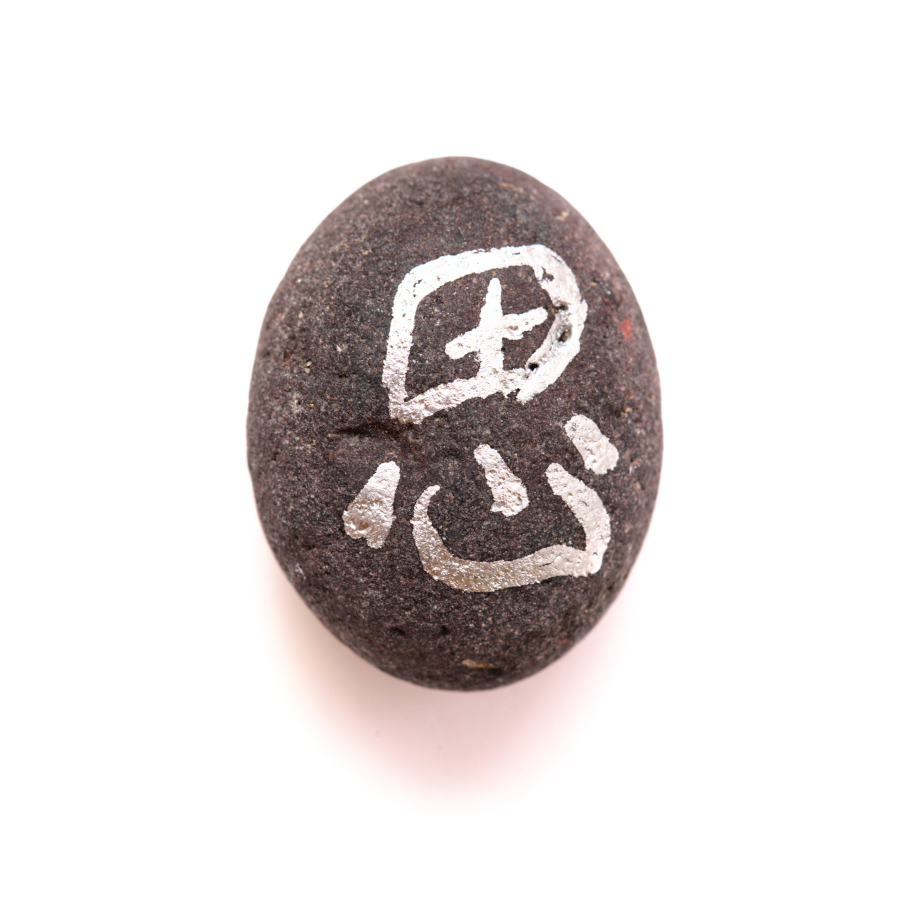
思 | sī

In Mandarin Chinese, 思 (Pinyin: sī 🔊) has several meanings related to our mental activity. It could be a verb for “to think”, “to miss”, “to yearn for”, “to hope”, “to wish”, “to lament” or “to grieve for”; or a noun for “thought”, “idea”, “feeling” or “mood”. So 我思你 or 我思妳 (wǒ sī nǐ) may mean “I miss you” or “I think about you”. Thus Cartesian Cogito, ergo sum, translated to Chinese as 我思故我在, acquires a wonderful polysemy: not just “I think therefore I am” but also “I hope therefore I am”, “I yearn therefore I am” and even “I grieve therefore I am” — all are aspects of human existence.

As you can see, 思 is made of 田 “field” on top of 心, “heart/mind”. But why “field”? According to Wiktionary, the original form of this character was 恖, a phono-semantic, or maybe also ideogrammic, compound of 囟 “fontanel” and 心 “heart”. Then 囟 was “corrupted” into the unrelated 田. The Uncle Hanzi’s page shows that this “corruption” was no more than a 45° rotation of the “cross in a box”; there’s much more variation in the shape of the “heart”.

Lawrence J. Howell writes in his Etymological Dictionary of Han/Chinese Characters:

The relevant oracle bone form of this character shows that the top element was originally not 田 field but a depiction of a profusion of fine bones in fontanels, open spaces in an infant’s skull over which the skull bones eventually fuse <...> 思 adds 心 heart/emotions → finely detailed thoughts → think; consider; believe → be sunk in thought.
Etymology aside, I prefer to think of 思 as a ship with a square sail and oars, because to think is to sail.

Compounds of 思 include

  • 三 + 思 = 三思 (sānsī): to think twice (literally, “think thrice”)
  • 不 + 思 = 不思 (bùsī): to not take into consideration
  • 思 + 春 = 思春 (sīchūn): to have thoughts of love
  • 思 + 力 = 思力 (sīlì): power of thought, intellect
  • 思 + 乡 “country”, “village” = 思乡 (sīxiāng): to be homesick
In Japanese, 思 (omu) seems to only have one meaning, “to think”.

柿に思ふ
奈良の旅籠の
下女の顔
子規
Kaki ni omou Nara no hatago no gejo no kao
The persimmons make me think
Of the face of a servant
At an inn of Nara.
年々に
菊に思はん
思はれん
子規
Nen nen ni kiku ni omowan omowaren
Every year
Thinking of the chrysanthemums,
Being thought of by them.
Shiki

(All haiku translated by R.H. Blyth)

More photos related to thought, hanzi and calligraphy @ Shutterstock.

Friday, 8 May 2020

熊 | xióng

In Mandarin Chinese, 熊 (Pinyin: xióng 🔊) means “bear” (a carnivoran mammal). Here is a possible mnemonic for those whose bear experience is limited to teddy bears: the pronunciation is similar to German schön 🔊 “beautiful” or non-standard (but widely understood) Russian щён “puppy”.

According to Wiktionary,

This character originally represented an onomatopoetic word [熊熊 {xióngxióng, “(of flame) raging”}]. Later its phonetic compound 能, the character for the Old Chinese word “bear”, was borrowed for another word. This character thus began to represent the word “bear” instead.

Lawrence J. Howell writes in his Etymological Dictionary of Han/Chinese Characters:

As per 能 (bear) + 火 fire → bear (← ancient belief associating bears with the spirit of fire).

(火 has got reduced to the four short strokes 灬 on the bottom of 熊.)

True, the bear is a complex character, maybe because you are not supposed to mention him too often (just as you are not supposed to abuse words like “love”)? At least 熊 does not contain any kind of “dog” in it (but see below).

熊 is a “simplified” form of a traditional character 熊. I put “simplified” in quotes because it does not look like a simplification at all. Both hanzi have 14 strokes and you really need to look hard to spot the difference, which boils down to a couple of strokes going askew.

Now there are bears and there are bears:

  • 白 + 熊 = 白熊 (báixióng): polar bear
  • 人 + 熊 = 人熊 (rénxióng): brown bear
  • 马 + 熊 = 马熊 (mǎxióng): another word for brown bear (literally “horse-bear”)
  • 狗 + 熊 = 狗熊 (gǒuxióng): Asian black bear (literally “dog-bear”)
  • 浣 + 熊 = 浣熊 (huànxióng 🔊): raccoon (literally “wash-bear”)
  • 熊 + 猫 = 熊猫 (xióngmāo 🔊): panda (literally “bear cat”)

Well, phylogenetically, raccoons are not bears (and red pandas are not foxes), but here you are.

More photos related to bears, beads and sea glass @ Shutterstock.

Thursday, 30 April 2020

狐 | hú

In Mandarin Chinese, 狐 (Pinyin: hú 🔊) means “fox”. According to Wiktionary, 狐 is a phono-semantic compound of semantic 犭, which is a radical form of 犬 (“dog”), and phonetic 瓜 (guā).

Lawrence J. Howell writes in his Etymological Dictionary of Han/Chinese Characters:

As per 瓜 (solitary) + 犬 dog/beast → fox (that, atypically for Canidae, goes about in small family units rather than in packs).

However, 瓜 means “melon” or “gourd” rather than “solitary”. I prefer to think of the whole right part of this character as of the fox’s long bushy tail — which is the first thing distinguishing a fox from other Canids that comes to my mind. Well, not just to my mind — cf. Valencian word rabosa or Portuguese raposa, both from rabo “tail”.

Since there are way too many Mandarin homonyms of hú, Chinese use 狐 in combination with other words, for example:

  • 狐 + 狸 = 狐狸 (húli 🔊): a fox; (figuratively) sly person
  • 赤 + 狐 = 赤狐 (chìhú): red fox (Vulpes vulpes)
  • 白 + 狐 = 白狐 (báihú): arctic fox
  • 沙 + 狐 = 沙狐 (shāhú): corsac fox (Vulpes corsac)
  • 火 + 狐 = 火狐 (huǒhú): red fox; red panda; Mozilla Firefox

狐狸精 (húlijīng), “fox spirit” or 九尾狐 (jiǔwěihú), “nine-tailed fox” refer to mythological creatures “who can be either good or bad spirits”:

Typically fox spirits were seen as dangerous, but some of the stories in the Qing dynasty book Liaozhai Zhiyi by Pu Songling are love stories between a fox appearing as a beautiful girl and a young human male. In the fantasy novel The Three Sui Quash the Demons’ Revolt, a huli jing teaches a young girl magic, enabling her to conjure armies with her spells.

(Let’s not use 狐狸精 in its modern derogatory and misogynist sense, OK?)

狐 (kitsune 🔊) also play a prominent role in Japanese folklore...

Stories depict legendary foxes as intelligent beings and as possessing paranormal abilities that increase with their age and wisdom. According to Yōkai folklore, all foxes have the ability to shapeshift into human form. While some folktales speak of kitsune employing this ability to trick others — as foxes in folklore often do — other stories portray them as faithful guardians, friends, lovers, and wives.

...as well as in poetry:

水仙に
狐遊ぶや
宵月夜
蕪村
Suisen ni kitsune asobu ya yoizukiyo
Foxes playing
Among the narcissus flowers
In the early evening moonlight.
飯ぬすむ
狐追ひ打つ
麦の秋
蕪村
Meshi nusumu kitsune oi utsu mugi no aki
Driving away with blows,
A fox stealing the rice;
The autumn of barley.
Buson

(Translated by R.H. Blyth)

More photos related to foxes, beads and sea glass @ Shutterstock.

Monday, 20 April 2020

蛙 | wā

In Mandarin Chinese, 蛙 (Pinyin: wā 🔊) is a word for frog.

According to Wiktionary, 蛙 is a phono-semantic compound of semantic 虫 (“insect; creature”) and phonetic 圭 which, in turn, is a duplication of our old friend 土. Now, English speakers think the frog goes “ribbit” (🔊). But this is only because of Baja California chorus frog who happen to live near Hollywood. For Dutch, frogs go “kwaak kwaak”, for Russians — “ква-ква” and for Chinese — 呱呱 (wā wā). If you remember “wā wā”, you’ll remember “wā” too.

Does 蛙 look like a frog? Not really, not to me. Look, here’s a frog:

And here’s a sailboat pursuing, er, two smaller boats:

In Japanese, 蛙 is pronounced kaeru (🔊) or, in poetry, kawazu. Here’s probably the most famous haiku ever:

古池や
蛙飛こむ
水の音
芭蕉
Furu ike ya kawazu tobikomu mizu no oto
The old pond;
A frog jumps in, —
The sound of the water.

I used the classic translation by R.H. Blyth; if you don’t like it, there are at least thirty-one others.

More photos related to frogs, calligraphy and sea glass @ Shutterstock.