Showing posts with label . Show all posts

Monday, 22 February 2021

安 | ān

In Mandarin Chinese, (Pinyin: ān 🔊) has many meanings but most of them are related to the concepts of peace and security. It could be an adjective meaning “calm”, “peaceful”, “tranquil”, “quiet”, “comfortable”, “safe”, “secure”, or a verb for “to calm”, “to be content with”, “to place”, “to find a place for”, “to fit”, “to set up”, “to bring”, “to cherish”, “to harbour”. In physics, is short for 安培 (ānpéi), “ampere”.

Lawrence J. Howell writes in his Etymological Dictionary of Han/Chinese Characters:

roof/building + woman → woman resting/at ease indoors → be at ease/peacecheap; inexpensive (← cheap enough to be purchased with ease).

The meaning “cheap”, however, is specific for Japanese, where the word (あん; an) has an additional sense in chemistry for “ammonium”. Also, according to Ponte Ryūrui,

The modern form of the hiragana character comes from the cursive form of the kanji .

Back to Chinese — many compounds of include

More photos related to calmness, calligraphy and sea glass @ Shutterstock.

Saturday, 6 February 2021

快 | kuài

In Mandarin Chinese, (Pinyin: kuài 🔊) is an adjective with many meanings: “fast”, “quick”, “sharp”, “clever”, “frank”, “straightforward”, “pleased”, “happy”. It is also used as an adverb meaning “soon” or “almost”.

According to Wiktionary, is a phono-semantic compound of phonetic (guài) and semantic , a radical form of , “heart/mind”.

Lawrence J. Howell writes in his Etymological Dictionary of Han/Chinese Characters:

As per (scoop out) + heart/emotions → pleasant; comfortable (← heart with all the unpleasantness scooped out of it) → refreshing; enjoyable.

Compounds of include

  • + = 快人 (kuàirén): a frank and open person
  • + = 快门 (kuàimén): shutter (of a camera)
  • + = 手快 (shǒukuài): fast; having quick hands
  • + = 飞快 (fēikuài): 1) razor sharp; 2) extremely fast, at lightning speed
  • + + + = 大快人心 (dàkuàirénxīn): to everybody’s satisfaction

More photos related to fast stuff, hanzi and calligraphy @ Shutterstock.

Monday, 6 April 2020

们 | men

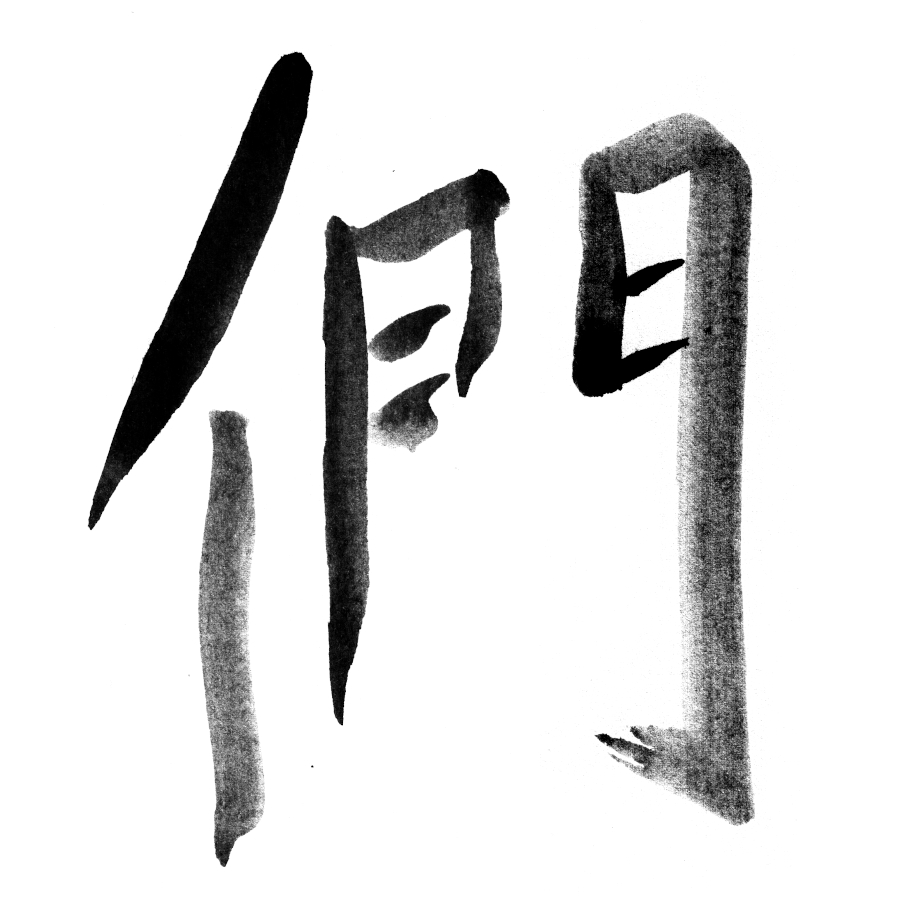
In Mandarin Chinese, (Pinyin: men 🔊) is a suffix used to form plurals for pronouns and some animate nouns. This character is a phono-semantic compound of semantic , a radical form of “person”, and phonetic (mén 🔊).

is a simplified form of the traditional character (as , you may recall, is a simplified form of ).

Important compounds of include

More photos related to hanzi and calligraphy @ Shutterstock.

Friday, 27 March 2020

门 | mén

In Mandarin Chinese, (Pinyin: mén 🔊) is a word of many meanings, all of which are ultimately derived from “gate”:

  1. gate; door; entrance; opening
  2. valve; switch
  3. knack, way of doing something
  4. school of thought
  5. class, category
  6. measure word used for academic subjects, courses and branches of technology

is a simplified form of the traditional character . Lawrence J. Howell in his Etymological Dictionary of Han/Chinese Characters describes as a

depiction of a curving, double-doored gate, the doors adhering tightly in concealing what lies behind it.

It won’t surprise you then to know that a half of this character, , means a single door.

I find the traditional character more pleasing aesthetically and easier to remember; the simplified one is easier to write but it makes me think rather of a fridge door or power switch than of the “real” gate.

The many compounds of include

  • + = 门口 (ménkǒu): entrance
  • + = 门人 (ménrén): door guard
  • + = 出门 (chūmén): to go out; to leave home for a far place; to get married (of a woman)
  • + = 龙门 (lóngmén): gateway to success; fame; glory
  • + = 山门 (shānmén): monastery gate
  • + = 水门 (shuǐmén): floodgate, sluice, water valve
  • + = 玉门 (yùmén): “jade gate” (literary, figuratively) palace; (euphemism) vulva

as well as Chinese toponyms such as

And not just Chinese: for example, 水门, apart from “floodgate”, is also a literal translation of Watergate. As the back-formed suffix -gate is used in English to form the names of scandals (such as Climategate, Irangate, Nipplegate etc.), so does in Chinese.

In Japanese, is pronounced mon or kado. We already read a haiku by Buson featuring gates; here are some more:


夜ふけて
たたく音
許六
Umorebi ya yo fukete mon wo tataku oto
A banked fire;
It is deep night;
Knocking at the gate.
Kyoroku

來て凍るなり
井の鐘
一茶
Kadoguchi ni kite kōrunari Mii no kane
Reaching the gate,
The bell of Mii temple
Freezes.
Issa

(All haiku translated by R.H. Blyth)

More photos of gates, doors and sea glass @ Shutterstock.