Showing posts with label . Show all posts

Friday, 1 May 2020

您 | nín

In Mandarin Chinese, (Pinyin: nín 🔊) is a polite or formal second-person pronoun that could be used in both singular and plural, like German Sie or Russian Вы. So 您好 (nín hǎo) is a polite way to say “hello”.

As you can see, is a combination of “you” (informal singular) with , “heart”. I see a genial, smiling face of a bearded man, whom I may wish to address politely — out of respect — but who wouldn’t mind my 你好 either.

More photos related to beads, hanzi and calligraphy @ Shutterstock.

Monday, 6 April 2020

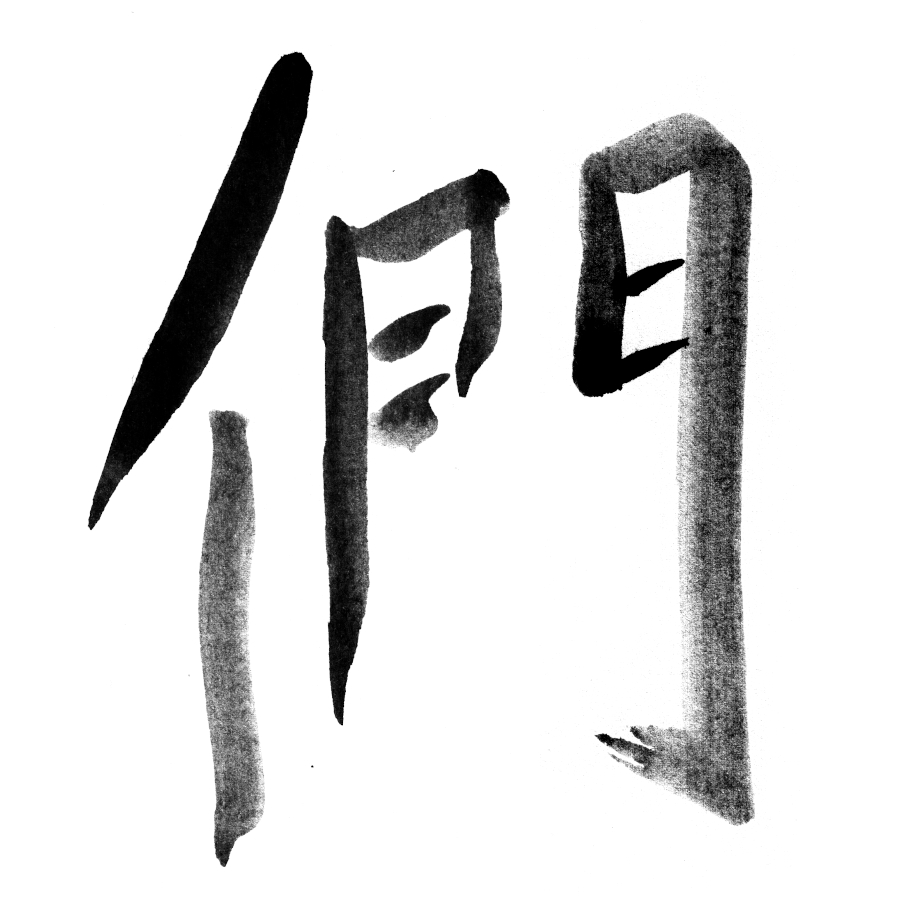
们 | men

In Mandarin Chinese, (Pinyin: men 🔊) is a suffix used to form plurals for pronouns and some animate nouns. This character is a phono-semantic compound of semantic , a radical form of “person”, and phonetic (mén 🔊).

is a simplified form of the traditional character (as , you may recall, is a simplified form of ).

Important compounds of include

More photos related to hanzi and calligraphy @ Shutterstock.

Friday, 3 April 2020

妳 | nǐ

So what have we learned so far about Chinese pronouns? Like in many Indo-European languages, there are gender-specific third person pronouns in written Chinese: “he” and “she”. Unlike many Indo-European languages, spoken Chinese does not differentiate between “him” and “her”: both are pronounced the same (Pinyin: 🔊).

But that’s not all. Also unlike many Indo-European languages, written Chinese has gender-specific second person pronouns: “you” (singular informal masculine) and “you” (singular informal feminine). In spoken Mandarin, there is no difference between and ( 🔊).

As you should have guessed by now, is derived from by replacing with . According to Wiktionary,

This character is mostly used in traditional Chinese when referring to a female person. Although is rarely used in simplified Chinese, it may still be found in some contexts.

More photos related to hanzi and calligraphy @ Shutterstock.

Monday, 30 March 2020

你 | nǐ

In Mandarin Chinese, (Pinyin: 🔊) means “you” (singular informal, like German du, Russian ты or Spanish ) or “your”. This is probably the first Chinese pronoun everybody learns without even realising: the greeting 你好 (nǐ hǎo 🔊), + , literally “you good?”, except this is not a question. (Nor, for that matter, is “how do you do”.)

According to Wiktionary, this character is a phono-semantic compound of semantic , a radical form of “person”, and phonetic , which is a simplified form of . Lawrence J. Howell in his Etymological Dictionary of Han/Chinese Characters gives a different explanation:

(= ) (adhere) + person → person with close and ongoing relations with oneself → you. Compare . Note the variant form .

Curiously (for us), in written Chinese there is a difference between feminine and masculine second-person pronouns:

In traditional Chinese, may be used to specifically refer to a male person, while can be used for a female person. In simplified Chinese, only is standard.

A combination of “you” and “I”, 你我 (nǐwǒ), rather unsurprisingly, means “you and I”.

More photos related to hanzi and calligraphy @ Shutterstock.