Showing posts with label . Show all posts

Tuesday, 2 February 2021

新 | xīn

In Mandarin Chinese, (Pinyin: xīn 🔊) is an adjective that means “new”, “fresh”, “recent”, etc., or a corresponding adverb. It was also the name of short-lived Xin dynasty, 新朝 (Xīncháo).

According to Wiktionary, is a phono-semantic compound of phonetic “hazelnut tree” and semantic “axe”:

to cut down a tree with an axe (hence starting something new).

Lawrence J. Howell in his Etymological Dictionary of Han/Chinese Characters gives a different explanation:

The left-hand element is an abbreviated form of one combining needle/cutting tool and tree/wood → thornbush (the sharp, needle-like thorns in close proximity). adds ax → create firewood by chopping a thornbush/tree with a sharp ax. New is an extended meaning (← freshly hewn tree/wood) → recently/lately.

Many compound words of include

  • + = 新月 (xīnyuè): new moon
  • + = 新年 (xīnnián 🔊): New Year
  • + = 新生 (xīnshēng): newborn; recent; to be born again; to be reborn
  • + = 新人 (xīnrén): newly married (couple, wife, husband); new lover; new personality; new talent; newcomer; new person; someone who is making a fresh start; Homo sapiens sapiens
  • + = 新娘 (xīnniáng 🔊): bride
  • + = 新郎 (xīnláng 🔊): bridegroom
  • + = 新星 (xīnxīng): (astronomy) nova; (figuratively) rising star
  • + 新星 = 超新星 (chāoxīnxīng): (astronomy) supernova
  • + 戊烷 “pentane” = 新戊烷 (xīnwùwán): (chemistry) neopentane
  • + = 新田 (xīntián): new field; new farmland
  • + = 新茶 (xīnchá): new tea of the year

More photos related to new stuff, hanzi and calligraphy @ Shutterstock.

Monday, 13 July 2020

石 | shí

In Mandarin Chinese, (Pinyin: shí 🔊) means “stone” or “rock”.

Lawrence J. Howell writes in his Etymological Dictionary of Han/Chinese Characters:

A depiction of a rock or stone beneath a cliff, suggesting a substantial pile of rocks/stones. Sterile/barren is by association (← rocky, barren soil), as is rigid (← rigid objects). Unit of volume is a borrowed meaning.

According to Wiktionary, this hanzi is a pictogram of

a stone beneath a cliff (). The cliff was subsequently distorted into . Alternatively, a cave set into the side of a cliff or mountain.

This latter hypothesis can explain why (“mouth” etc.) is a part of .

Some compounds of include

  • + = 火石 (huǒshí): flint
  • + = 玉石 (yùshí): jade stone; (figuratively) good and bad
  • + + = 白云石 (báiyúnshí): dolomite
  • + = 石子 (shízǐ): pebble
  • + = 石工 (shígōng): stonemason, mason
  • + = 石田 (shítián): (literary) uncultivable land; (literary, figuratively) useless thing
  • + = 石油 (shíyóu 🔊) ): petroleum

More photos related to rocks and stones @ Shutterstock.

Saturday, 23 May 2020

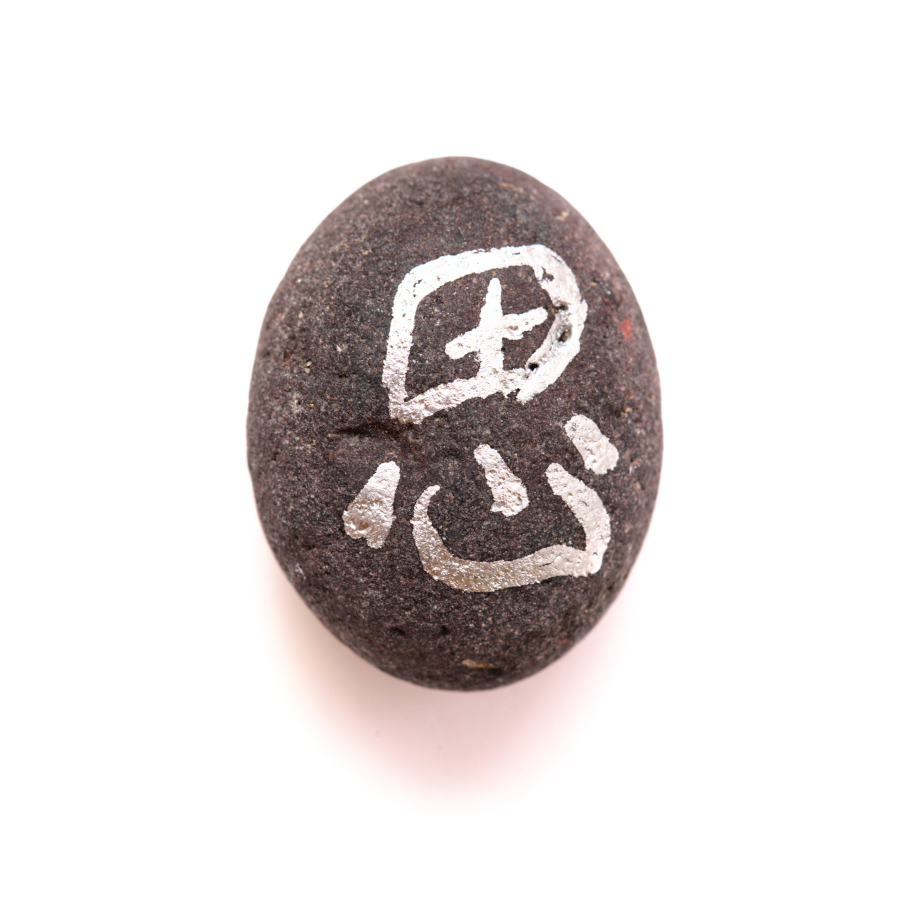
思 | sī

In Mandarin Chinese, (Pinyin: 🔊) has several meanings related to our mental activity. It could be a verb for “to think”, “to miss”, “to yearn for”, “to hope”, “to wish”, “to lament” or “to grieve for”; or a noun for “thought”, “idea”, “feeling” or “mood”. So or 我思 (wǒ sī nǐ) may mean “I miss you” or “I think about you”. Thus Cartesian Cogito, ergo sum, translated to Chinese as 我思故我在, acquires a wonderful polysemy: not just “I think therefore I am” but also “I hope therefore I am”, “I yearn therefore I am” and even “I grieve therefore I am” — all are aspects of human existence.

As you can see, is made of “field” on top of , “heart/mind”. But why “field”? According to Wiktionary, the original form of this character was , a phono-semantic, or maybe also ideogrammic, compound of “fontanel” and “heart”. Then was “corrupted” into the unrelated . The Uncle Hanzi’s page shows that this “corruption” was no more than a 45° rotation of the “cross in a box”; there’s much more variation in the shape of the “heart”.

Lawrence J. Howell writes in his Etymological Dictionary of Han/Chinese Characters:

The relevant oracle bone form of this character shows that the top element was originally not field but a depiction of a profusion of fine bones in fontanels, open spaces in an infant’s skull over which the skull bones eventually fuse <...> adds heart/emotions → finely detailed thoughts → think; consider; believebe sunk in thought.
Etymology aside, I prefer to think of as a ship with a square sail and oars, because to think is to sail.

Compounds of include

  • + = 三思 (sānsī): to think twice (literally, “think thrice”)
  • + = 不思 (bùsī): to not take into consideration
  • + = 思春 (sīchūn): to have thoughts of love
  • + = 思力 (sīlì): power of thought, intellect
  • + “country”, “village” = 思乡 (sīxiāng): to be homesick
In Japanese, (omu) seems to only have one meaning, “to think”.

柿に
奈良の旅籠の
の顔
子規
Kaki ni omou Nara no hatago no gejo no kao
The persimmons make me think
Of the face of a servant
At an inn of Nara.
々に
菊にはん
はれん
子規
Nen nen ni kiku ni omowan omowaren
Every year
Thinking of the chrysanthemums,
Being thought of by them.
Shiki

(All haiku translated by R.H. Blyth)

More photos related to thought, hanzi and calligraphy @ Shutterstock.

Thursday, 22 February 2018

田 | tián

In Mandarin Chinese, (Pinyin: tián 🔊) is a noun that means “field”, “paddy” or “farmland”. “is one of the 1000 most commonly used words” in the Collins Chinese Dictionary. Some compound words of include

As a radical, is found in many hanzi. We’ve seen it in “seedling” (grass emerging from a field), “man” (working the field used to be a man’s job) and “yellow” (presumably, colour of earth).

More photos related to fields and sea glass @ Shutterstock.

Wednesday, 21 February 2018

苗 | miáo

In Mandarin Chinese, (Pinyin: miáo 🔊) is a noun that means “seedling”, “sprout”, “young” (of an animal), “descendant”, “offspring” and so on. Some compound words of include

  • + = 苗木 (miáomù): young tree, sapling
  • + = 苗子 (miáozi): a talented child, “budding”, “in the making”
  • + = 火苗 (huǒmiáo): tongue of flame

According to Wiktionary, is an ideogrammic compound of “grass” and “field”. But what it has to do with , “cat”? The origin of the word (māo) is purely onomatopoetic: the cat is an animal that meows 🔊. Likewise, the word for this very sound, (miāo), “meow”, is a phono-semantic compound of semantic “mouth” and phonetic .

More photos related to sprouts, shoots, seedlings and sea glass @ Shutterstock.

Wednesday, 23 August 2017

黄 | huáng

In Mandarin Chinese, (Pinyin: huáng 🔊) is an adjective meaning “yellow”. You must have heard this word as a part of 黄河 (黃河, Huáng Hé 🔊), the Yellow River. also can mean “pornographic”.

is a simplified form of . According to Wiktionary, is a phono-semantic compound of phonetic (guāng) and semantic “field”, yellow (supposedly) being the colour of earth.

More photos related to colour yellow and chanterelle mushrooms @ Shutterstock.

Thursday, 4 May 2017

男 | nán

In Mandarin Chinese, (Pinyin: nán 🔊) means “male” or “son”. A combination with “people”, 男人 (nánrén 🔊), means “(an adult) man” or “husband”.

is made of two ideograms: “field” and “strength” (this latter character could have evolved from a pictogram of a plough). In old times, ploughing (and working the field in general) was a man’s job. In most of the historical forms of , the “field” is positioned either on top or to the left of the “plough”. Also, in an alternative character the “field” is on the left side. The “plough” part looks a bit like lower-case letter n which helps me to remember that nán is a “man” which starts with n.

More photos related to men and sea glass @ Shutterstock.