Showing posts with label beads. Show all posts

Friday, 2 October 2020

蛛 | zhū

In Mandarin Chinese, 蛛 (Pinyin: zhū 🔊) means “spider”. According to Wiktionary, 蛛 is a phono-semantic compound of semantic 虫 (“insect”) and phonetic 朱 (zhū), while Lawrence J. Howell writes in his Etymological Dictionary of Han/Chinese Characters that “the conceptual influence lent here by 朱 is uncertain”.

There are not too many compounds of 蛛. One of them is 蜘蛛 (zhīzhū 🔊) which is another word for spider. In Chinese, the 蜘 part is not used on its own; in Japanese, Korean and Vietnamese 蜘 also means “spider”. So does the reduplicated form, 蛛蛛 (zhūzhu). A compound of 蛛 with 网 “net”, 蛛网 (zhūwǎng), means “spider web”.

In Japanese, 蜘蛛 is pronounced kumo (🔊).

蜘蛛何と
音を何と鳴く
秋の風
芭蕉
Kumo nan to oto wo nan to naku aki no kaze
With what voice,
And what song would you sing, spider,
In this autumn breeze?
Bashō

(Translated by R.H. Blyth)

More photos related to spiders, calligraphy and sea glass @ Shutterstock.

Friday, 11 September 2020

꩜ | spiral

꩜

Just like the eight-pointed “Guanche sun” (or star), the spiral is something that you’re bound to see wherever you go in Canaries. It is also featured prominently in the art of Canarian artists such as Óscar Domínguez, Martín Chirino and Manolo Millares.

꩜

Of course, there is nothing specifically “Guanche” about it: the spiral is one of the most universal symbols. We are surrounded by natural and man-made spirals: callas, cinnamon buns, fern shoots, Romanesco buds, seashells, snails, staircases, sushi rolls, vinyl grooves, violin scrolls, waves and wreaths. The spiral is found in many symbols, including @, lauburu, G-clef and F-clef. In Cham, the character ꩜ is a punctuation mark for the beginning of a section.

꩜

Juan Eduardo Cirlot wrote in his Dictionary of Symbols:

Spiral: A schematic image of the evolution of the universe. It is also a classical form symbolizing the orbit of the moon, and a symbol for growth, related to the Golden Number, arising <...> out of the concept of the rotation of the earth. In the Egyptian system of hieroglyphs the spiral — corresponding to the Hebrew vau — denotes cosmic forms in motion, or the relationship between unity and multiplicity. <...> Be that as it may, the spiral is certainly one of the essential motifs of the symbolism of ornamental art all over the world, either in the simple form of a curve curling up from a given point, or in the shape of scrolls, or sigmas, etc.

꩜

More photos related to Guanches, spirals, beads and sea glass @ Shutterstock.

Thursday, 27 August 2020

❂ | Guanche sun

Google Guanche+sun, sol+guanche, sol+canario+simbolo etc. etc. and you’re bound to see this symbol. Come to any souvenir shop in Canaries and you’ll see it there.

I am not sure that it is even a solar symbol, maybe it is a star. It is known though that Guanches worshipped a solar deity named Magec.

I couldn’t find much information about this symbol on the web; it looks like most common “Guanche” design is based on the pintadera no. 3080 in El Museo Canario [M.ª del Carmen Cruz de Mercadal, Teresa Delgado Darias, Javier Velasco Vázquez, Pintaderas de El Museo Canario; El Museo Canario, 2013].

This symbol is based on a regular octagram (Schläfli symbol {8/3}) and not on the Star of Lakshmi (Schläfli symbol {8/2}) and its variants, Rub el Hizb and al-Quds star. However, you can clearly see that the eight intersecting lines of the octagram form the Star of Lakshmi which is completely covered by a circle in the “Guanche sun”.

More photos related to Guanches, sun, stars, octagrams and sea glass @ Shutterstock.

Tuesday, 26 May 2020

手 | shǒu

In Mandarin Chinese, 手 (Pinyin: shǒu 🔊) means “hand”. It also has a number of derived meanings such as “handy”, “portable”, “handwritten”, or used as a suffix to create names of specialists or experts in something.

Lawrence J. Howell writes in his Etymological Dictionary of Han/Chinese Characters:

A depiction of a hand showing the five fingers in a curved, gripping position. Extended meanings include arm; paw; foreleg; a handle; helper; a means; technique; (in board games) a move; a type; a direction; and handwriting.

Ponte Ryūrui notes:

Although the modern form of the character 手 may be somewhat misleading (6 fingers), the “hand” radical 扌 still resembles the ancient pictographs. <...> The upper stroke in standard script is the result of aesthetical modification made to the first stroke in the cursive hand which imitates the “middle finger”.

Compounds of 手 include

  • 手 + 工 = 手工 (shǒugōng 🔊): handwork; manually
  • 水 + 手 = 水手 (shuǐshǒu 🔊): saylor
  • 一 + 手 = 一手 (yīshǒu): single-handedly; proficiency, skill
  • 好 + 手 = 好手 (hǎoshǒu): expert, professional
  • 生 + 手 = 生手 (shēngshǒu): novice, new to a job
  • 国 + 手 = 国手 (guóshǒu): national champion, grand master
  • 出 + 手 = 出手 (chūshǒu): to sell (goods); to spend (money)
  • 入 + 手 = 入手 (rùshǒu): to start with, to begin with; to buy, to obtain

In Japanese, 手 can be pronounced as te 🔊, as in 空手 karate 🔊, or shu, as in 選手 senshu 🔊 “player”.

手に戻る
鷹の眼に
入る日哉
大魯
Te ni modoru taka no manako ni irihi kana
The sun,
In the eye of the falcon
That returned to my hand.
Tairo

Japanese has different logic (from that of Chinese), and in some compounds of 手 you may hear neither te nor shu. For instance, 上手 “skillful” or “good at” is pronounced jōzu but 下手 “unskilled” or “bad at” is pronounced heta:

世の中は
なく虫さへも
上手下手
一茶
Yo no naka wa naku mushi sae mo jōzu heta
Even among insects, in this world,
Some are good at singing,
Some bad.
Issa

(All haiku translated by R.H. Blyth)

More photos related to hands, beads, hanzi and calligraphy @ Shutterstock.

Saturday, 23 May 2020

思 | sī

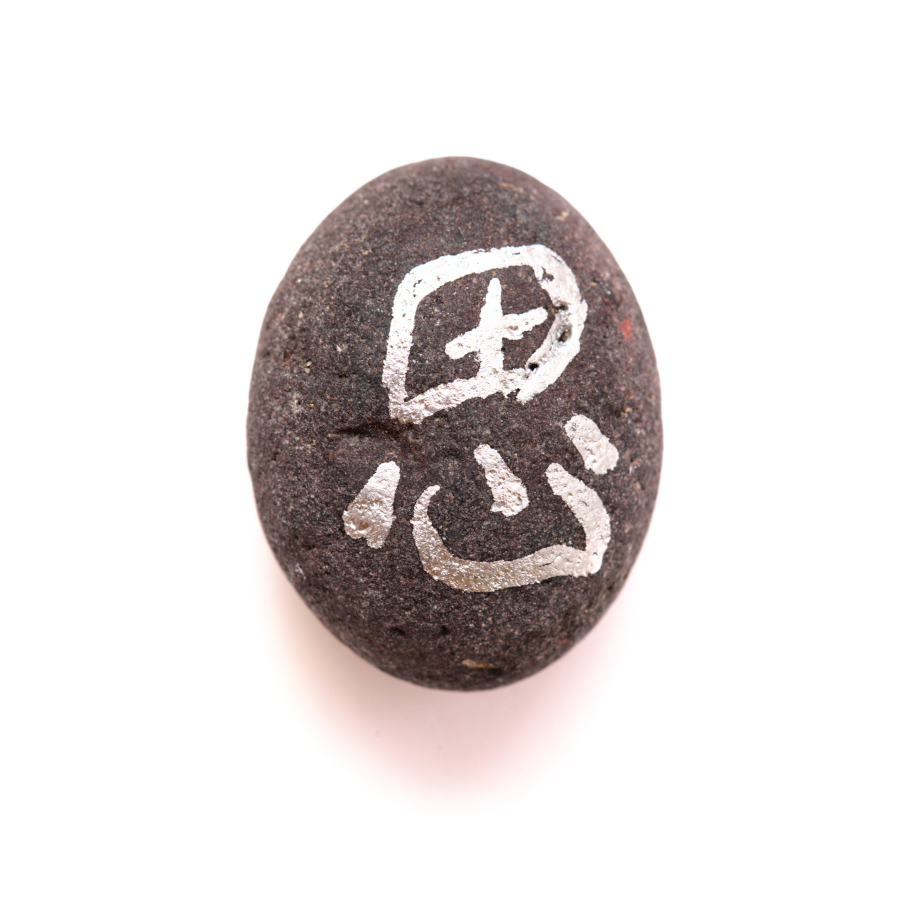
In Mandarin Chinese, 思 (Pinyin: sī 🔊) has several meanings related to our mental activity. It could be a verb for “to think”, “to miss”, “to yearn for”, “to hope”, “to wish”, “to lament” or “to grieve for”; or a noun for “thought”, “idea”, “feeling” or “mood”. So 我思你 or 我思妳 (wǒ sī nǐ) may mean “I miss you” or “I think about you”. Thus Cartesian Cogito, ergo sum, translated to Chinese as 我思故我在, acquires a wonderful polysemy: not just “I think therefore I am” but also “I hope therefore I am”, “I yearn therefore I am” and even “I grieve therefore I am” — all are aspects of human existence.

As you can see, 思 is made of 田 “field” on top of 心, “heart/mind”. But why “field”? According to Wiktionary, the original form of this character was 恖, a phono-semantic, or maybe also ideogrammic, compound of 囟 “fontanel” and 心 “heart”. Then 囟 was “corrupted” into the unrelated 田. The Uncle Hanzi’s page shows that this “corruption” was no more than a 45° rotation of the “cross in a box”; there’s much more variation in the shape of the “heart”.

Lawrence J. Howell writes in his Etymological Dictionary of Han/Chinese Characters:

The relevant oracle bone form of this character shows that the top element was originally not 田 field but a depiction of a profusion of fine bones in fontanels, open spaces in an infant’s skull over which the skull bones eventually fuse <...> 思 adds 心 heart/emotions → finely detailed thoughts → think; consider; believe → be sunk in thought.
Etymology aside, I prefer to think of 思 as a ship with a square sail and oars, because to think is to sail.

Compounds of 思 include

  • 三 + 思 = 三思 (sānsī): to think twice (literally, “think thrice”)
  • 不 + 思 = 不思 (bùsī): to not take into consideration
  • 思 + 春 = 思春 (sīchūn): to have thoughts of love
  • 思 + 力 = 思力 (sīlì): power of thought, intellect
  • 思 + 乡 “country”, “village” = 思乡 (sīxiāng): to be homesick
In Japanese, 思 (omu) seems to only have one meaning, “to think”.

柿に思ふ
奈良の旅籠の
下女の顔
子規
Kaki ni omou Nara no hatago no gejo no kao
The persimmons make me think
Of the face of a servant
At an inn of Nara.
年々に
菊に思はん
思はれん
子規
Nen nen ni kiku ni omowan omowaren
Every year
Thinking of the chrysanthemums,
Being thought of by them.
Shiki

(All haiku translated by R.H. Blyth)

More photos related to thought, hanzi and calligraphy @ Shutterstock.

Friday, 8 May 2020

熊 | xióng

In Mandarin Chinese, 熊 (Pinyin: xióng 🔊) means “bear” (a carnivoran mammal). Here is a possible mnemonic for those whose bear experience is limited to teddy bears: the pronunciation is similar to German schön 🔊 “beautiful” or non-standard (but widely understood) Russian щён “puppy”.

According to Wiktionary,

This character originally represented an onomatopoetic word [熊熊 {xióngxióng, “(of flame) raging”}]. Later its phonetic compound 能, the character for the Old Chinese word “bear”, was borrowed for another word. This character thus began to represent the word “bear” instead.

Lawrence J. Howell writes in his Etymological Dictionary of Han/Chinese Characters:

As per 能 (bear) + 火 fire → bear (← ancient belief associating bears with the spirit of fire).

(火 has got reduced to the four short strokes 灬 on the bottom of 熊.)

True, the bear is a complex character, maybe because you are not supposed to mention him too often (just as you are not supposed to abuse words like “love”)? At least 熊 does not contain any kind of “dog” in it (but see below).

熊 is a “simplified” form of a traditional character 熊. I put “simplified” in quotes because it does not look like a simplification at all. Both hanzi have 14 strokes and you really need to look hard to spot the difference, which boils down to a couple of strokes going askew.

Now there are bears and there are bears:

  • 白 + 熊 = 白熊 (báixióng): polar bear
  • 人 + 熊 = 人熊 (rénxióng): brown bear
  • 马 + 熊 = 马熊 (mǎxióng): another word for brown bear (literally “horse-bear”)
  • 狗 + 熊 = 狗熊 (gǒuxióng): Asian black bear (literally “dog-bear”)
  • 浣 + 熊 = 浣熊 (huànxióng 🔊): raccoon (literally “wash-bear”)
  • 熊 + 猫 = 熊猫 (xióngmāo 🔊): panda (literally “bear cat”)

Well, phylogenetically, raccoons are not bears (and red pandas are not foxes), but here you are.

More photos related to bears, beads and sea glass @ Shutterstock.

Friday, 1 May 2020

您 | nín

In Mandarin Chinese, 您 (Pinyin: nín 🔊) is a polite or formal second-person pronoun that could be used in both singular and plural, like German Sie or Russian Вы. So 您好 (nín hǎo) is a polite way to say “hello”.

As you can see, 您 is a combination of 你 “you” (informal singular) with 心, “heart”. I see a genial, smiling face of a bearded man, whom I may wish to address politely — out of respect — but who wouldn’t mind my 你好 either.

More photos related to beads, hanzi and calligraphy @ Shutterstock.

Thursday, 30 April 2020

狐 | hú

In Mandarin Chinese, 狐 (Pinyin: hú 🔊) means “fox”. According to Wiktionary, 狐 is a phono-semantic compound of semantic 犭, which is a radical form of 犬 (“dog”), and phonetic 瓜 (guā).

Lawrence J. Howell writes in his Etymological Dictionary of Han/Chinese Characters:

As per 瓜 (solitary) + 犬 dog/beast → fox (that, atypically for Canidae, goes about in small family units rather than in packs).

However, 瓜 means “melon” or “gourd” rather than “solitary”. I prefer to think of the whole right part of this character as of the fox’s long bushy tail — which is the first thing distinguishing a fox from other Canids that comes to my mind. Well, not just to my mind — cf. Valencian word rabosa or Portuguese raposa, both from rabo “tail”.

Since there are way too many Mandarin homonyms of hú, Chinese use 狐 in combination with other words, for example:

  • 狐 + 狸 = 狐狸 (húli 🔊): a fox; (figuratively) sly person
  • 赤 + 狐 = 赤狐 (chìhú): red fox (Vulpes vulpes)
  • 白 + 狐 = 白狐 (báihú): arctic fox
  • 沙 + 狐 = 沙狐 (shāhú): corsac fox (Vulpes corsac)
  • 火 + 狐 = 火狐 (huǒhú): red fox; red panda; Mozilla Firefox

狐狸精 (húlijīng), “fox spirit” or 九尾狐 (jiǔwěihú), “nine-tailed fox” refer to mythological creatures “who can be either good or bad spirits”:

Typically fox spirits were seen as dangerous, but some of the stories in the Qing dynasty book Liaozhai Zhiyi by Pu Songling are love stories between a fox appearing as a beautiful girl and a young human male. In the fantasy novel The Three Sui Quash the Demons’ Revolt, a huli jing teaches a young girl magic, enabling her to conjure armies with her spells.

(Let’s not use 狐狸精 in its modern derogatory and misogynist sense, OK?)

狐 (kitsune 🔊) also play a prominent role in Japanese folklore...

Stories depict legendary foxes as intelligent beings and as possessing paranormal abilities that increase with their age and wisdom. According to Yōkai folklore, all foxes have the ability to shapeshift into human form. While some folktales speak of kitsune employing this ability to trick others — as foxes in folklore often do — other stories portray them as faithful guardians, friends, lovers, and wives.

...as well as in poetry:

水仙に
狐遊ぶや
宵月夜
蕪村
Suisen ni kitsune asobu ya yoizukiyo
Foxes playing
Among the narcissus flowers
In the early evening moonlight.
飯ぬすむ
狐追ひ打つ
麦の秋
蕪村
Meshi nusumu kitsune oi utsu mugi no aki
Driving away with blows,
A fox stealing the rice;
The autumn of barley.
Buson

(Translated by R.H. Blyth)

More photos related to foxes, beads and sea glass @ Shutterstock.

Sunday, 19 April 2020

工 | gōng

In Mandarin Chinese, 工 (Pinyin: gōng 🔊) has a variety of meanings related to work. Apart from “work” itself, it could stand for “worker”, “working class”, “working day”, “industry”, “skill” or “project”.

According to Wiktionary, 工 is a pictogram of “a bladed tool”. What tool? Many historical forms of this character remind me of a spade or a shovel. Or maybe of an axe head — cf. 王 (which is like 工 with an extra stroke) and discussion therein. On the other hand, Lawrence J. Howell writes in his Etymological Dictionary of Han/Chinese Characters that 工 is

A depiction of a long hollow tube used as a tool both to pierce and to connect → work; construct (← work/construct using connecting pipes/tubes) → artisan; specialist; skillful.

Many compounds of 工 include

  • 工 + 人 = 工人 (gōngrén 🔊): worker, labourer
  • 人 + 工 = 人工 (réngōng 🔊): man-made, artificial
  • 木 + 工 = 木工 (mùgōng): woodwork, carpentry; woodworker, carpenter
  • 小 + 工 = 小工 (xiǎogōng): unskilled worker
  • 大 + 工 = 大工 (dàgōng): (literary) skilled worker; carpenter
  • 天 + 工 = 天工 (tiāngōng): (literary) work of nature

More photos related to beads, hanzi and calligraphy @ Shutterstock.