Showing posts with label pronoun. Show all posts

Monday, 1 June 2020

牠 | tā

In traditional Mandarin Chinese, (Pinyin: 🔊) is a third-person singular pronoun for animals. So it’s a different “it” from “it”.

, just like and , is a phono-semantic compound, in this case of semantic , a radical form of “ox”, “cow” etc., and phonetic .

is not found in simplified Chinese. Instead, the same is used for all non-human objects, animate or not.

More photos related to animals, hanzi and calligraphy @ Shutterstock.

Saturday, 30 May 2020

它 | tā

‘This, ladies and gentlemen, is the proverbial “it”.’

In Mandarin Chinese, (Pinyin: 🔊) is a third-person singular pronoun for inanimate objects; in simplified Chinese, it’s also a third-person singular pronoun for animals. In any case, in English it’s translated as “it”.

According to Wiktionary, its original meaning was “a snake”, which, as we know, now is taken over by :

The character was later borrowed for the then-homophonous third-person pronoun (“he/she/it”). Today () is used for male or gender-unspecified “he” and () for “she”.

More photos related to hanzi and calligraphy @ Shutterstock.

Friday, 1 May 2020

您 | nín

In Mandarin Chinese, (Pinyin: nín 🔊) is a polite or formal second-person pronoun that could be used in both singular and plural, like German Sie or Russian Вы. So 您好 (nín hǎo) is a polite way to say “hello”.

As you can see, is a combination of “you” (informal singular) with , “heart”. I see a genial, smiling face of a bearded man, whom I may wish to address politely — out of respect — but who wouldn’t mind my 你好 either.

More photos related to beads, hanzi and calligraphy @ Shutterstock.

Monday, 6 April 2020

们 | men

In Mandarin Chinese, (Pinyin: men 🔊) is a suffix used to form plurals for pronouns and some animate nouns. This character is a phono-semantic compound of semantic , a radical form of “person”, and phonetic (mén 🔊).

is a simplified form of the traditional character (as , you may recall, is a simplified form of ).

Important compounds of include

More photos related to hanzi and calligraphy @ Shutterstock.

Friday, 3 April 2020

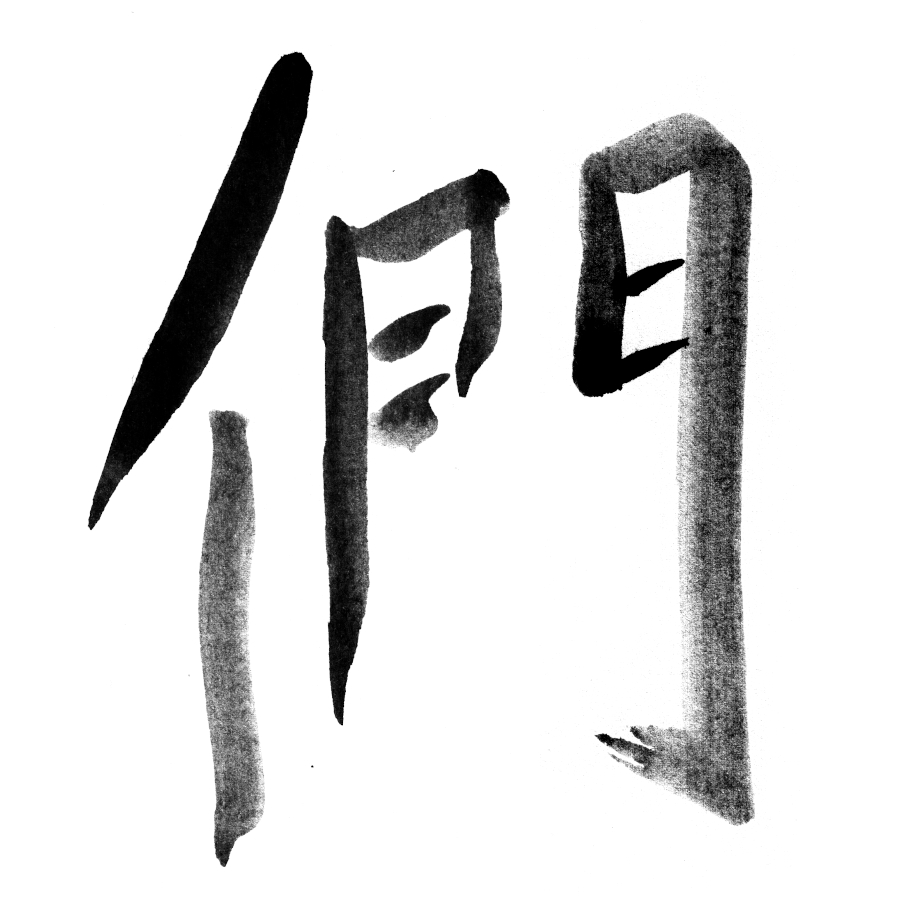
妳 | nǐ

So what have we learned so far about Chinese pronouns? Like in many Indo-European languages, there are gender-specific third person pronouns in written Chinese: “he” and “she”. Unlike many Indo-European languages, spoken Chinese does not differentiate between “him” and “her”: both are pronounced the same (Pinyin: 🔊).

But that’s not all. Also unlike many Indo-European languages, written Chinese has gender-specific second person pronouns: “you” (singular informal masculine) and “you” (singular informal feminine). In spoken Mandarin, there is no difference between and ( 🔊).

As you should have guessed by now, is derived from by replacing with . According to Wiktionary,

This character is mostly used in traditional Chinese when referring to a female person. Although is rarely used in simplified Chinese, it may still be found in some contexts.

More photos related to hanzi and calligraphy @ Shutterstock.

Wednesday, 1 April 2020

她 | tā

In Mandarin Chinese, (Pinyin: 🔊) is a personal pronoun “she” or “her”.

According to Wiktionary, is a phono-semantic compound of semantic “female”, “woman” and phonetic ( 🔊, which, however, sounds nothing like ). This is the rare case when it is known who and when invented this character:

Originally a variant of (jiě, “elder sister”). Later repurposed as a feminine third-person pronoun influenced by European languages, with the glyph being the result of replacing the (“person”) radical in () with (“woman”). Linguist Liu Bannong is credited with coining this use around the 1910s.

Liu Bannong (1891—1934) also popularised its use by writing the lyrics for a 1930s “hit” song 教我如何不想她 (Jiào wǒ rúhé bùxiǎng tā, “Tell me how to stop thinking of her”) composed by Yuen Ren Chao.

More photos related to hanzi and calligraphy @ Shutterstock.

Tuesday, 31 March 2020

他 | tā

In Mandarin Chinese, (Pinyin: 🔊) is a personal pronoun “he” or “him”. It also can mean “other” or “another”.

According to Wiktionary, this character is a phono-semantic compound of semantic , a radical form of “person”, and phonetic ( 🔊, which, however, sounds nothing like ). Lawrence J. Howell writes in his Etymological Dictionary of Han/Chinese Characters that is

a variant form of , and thus the meanings another person → other; separate.
did not become gender-specific until 20th century:
Originally gender-neutral before the 1910s, when modern (, “she; her”) was coined; now usually refers to males (also occasionally refers to females).

is used in many compounds in the meaning “other”/“another”:

  • + = 他人 (tārén): other people; others
  • + = 他日 (tārì): another day
  • + = 他国 (tāguó): foreign country
  • + = 他心 (tāxīn): ulterior motives

More photos related to hanzi and calligraphy @ Shutterstock.

Monday, 30 March 2020

你 | nǐ

In Mandarin Chinese, (Pinyin: 🔊) means “you” (singular informal, like German du, Russian ты or Spanish ) or “your”. This is probably the first Chinese pronoun everybody learns without even realising: the greeting 你好 (nǐ hǎo 🔊), + , literally “you good?”, except this is not a question. (Nor, for that matter, is “how do you do”.)

According to Wiktionary, this character is a phono-semantic compound of semantic , a radical form of “person”, and phonetic , which is a simplified form of . Lawrence J. Howell in his Etymological Dictionary of Han/Chinese Characters gives a different explanation:

(= ) (adhere) + person → person with close and ongoing relations with oneself → you. Compare . Note the variant form .

Curiously (for us), in written Chinese there is a difference between feminine and masculine second-person pronouns:

In traditional Chinese, may be used to specifically refer to a male person, while can be used for a female person. In simplified Chinese, only is standard.

A combination of “you” and “I”, 你我 (nǐwǒ), rather unsurprisingly, means “you and I”.

More photos related to hanzi and calligraphy @ Shutterstock.

Saturday, 28 March 2020

我 | wǒ

In Mandarin Chinese, (Pinyin: 🔊) is a pronoun meaning “I”, “me”, “my”, or “self”, or (in literary or formal use) “we”, “us”, or “our”. You’d think this word, common as it is, should be among the easiest to write. Wrong.

According to Wiktionary, this character is

a pictogram of a rake-like tool or weapon (note the oracle bone script form) <...> It was already borrowed for sound to mean “I” since the oracle bone script. Folk etymology considers it to be an ideograph of a hand () holding a weapon () to protect oneself.

Lawrence J. Howell writes in his Etymological Dictionary of Han/Chinese Characters:

The relevant oracle bone form of this character is a variant of spear/halberd, indicating a weapon/knife with a serrated blade (i.e., a blade the teeth of which are in alignment).

The Uncle Hanzi’s page shows the evolution of the pictogram from “rake” to its current form.

More photos related to hanzi and calligraphy @ Shutterstock.