Showing posts with label music. Show all posts

Thursday, 11 February 2021

乐 | yuè | lè

In Mandarin Chinese, 乐 is a character for two different words:

  1. 乐 (Pinyin: yuè 🔊): n. music, tune, melody, song
  2. 乐 (Pinyin: lè 🔊): adj. joyful, happy, glad, enjoyable, fun; n. happiness, joy, pleasure; v. to laugh, to smile, to enjoy, to love

乐 is a simplified form of the traditional character 樂. According to Wiktionary, 樂 is an

Ideogrammic compound: 糸 (“string”) + 木 (“wood”) — strings on a piece of wood, i.e. a wooden musical instrument. The oracle bone form shows two strings connected to the wood. In the bronze inscriptions, a 白 component was added in between the two strings, which may either represent the thumb (fiddling) or a phonetic part.

Lawrence J. Howell in his Etymological Dictionary of Han/Chinese Characters gives a different explanation:

A depiction of an oak tree with acorns (ground into powder via a lengthy grinding process). Music and enjoyment are onomatopoeic, borrowed meanings, the pronunciation of the character simulating the din of a crowd → play (an instrument); amuse oneself; pleasant; fun; happy; delightful; comfort; easy.

Compounds of 乐 (1) include

  • 乐 + 队 “team” = 乐队 (yuèduì): music band
  • 国 + 乐 = 国乐 (guóyuè): national music
  • 俗 “common” + 乐 = 俗乐 (súyuè): folk music
  • 西 + 乐 = 西乐 (xīyuè): Western music

And those of 乐 (2):

  • 乐 + 土 = 乐土 (lètǔ): land of happiness; paradise
  • 乐 + 子 = 乐子 (lèzi): a little fun; a good time
  • 快 + 乐 = 快乐 (kuàilè 🔊): happy; joyful; cheerful

One of the meaning of 快 is “happy”, so 快乐 is like “happy happy”. In its turn, 快乐 is a part of many “happy” wishes such as

In Japanese, a simplified (shinjitai) form of 樂 is used, viz. 楽. Similar to Chinese, 楽 corresponds to two different words:

  1. がく (gaku): n. music
  2. らく (raku): adj. comfortable, easy, simple; n. comfort, ease, enjoyment, simplicity

楽書の
壁をあはれむ
今朝の雪
蕪村
Rakugaki no kabe wo awaremu kesa no yuki
The scribbling on the wall, —
It looks pitiful,
This morn of snow.
Buson

(Translated by R.H. Blyth)

Here, 楽書, literally “writing for fun”, is an alternative way to spell 落書き / らくがき (rakugaki 🔊), “doodle”, “graffiti”, “scrawl”, “scribble”, etc.

More photos related to music, happiness, hanzi and calligraphy @ Shutterstock.

Wednesday, 1 April 2020

她 | tā

In Mandarin Chinese, 她 (Pinyin: tā 🔊) is a personal pronoun “she” or “her”.

According to Wiktionary, 她 is a phono-semantic compound of semantic 女 “female”, “woman” and phonetic 也 (yě 🔊, which, however, sounds nothing like tā). This is the rare case when it is known who and when invented this character:

Originally a variant of 姐 (jiě, “elder sister”). Later repurposed as a feminine third-person pronoun influenced by European languages, with the glyph being the result of replacing the 人 (“person”) radical in 他 (tā) with 女 (“woman”). Linguist Liu Bannong is credited with coining this use around the 1910s.

Liu Bannong (1891—1934) also popularised its use by writing the lyrics for a 1930s “hit” song 教我如何不想她 (Jiào wǒ rúhé bùxiǎng tā, “Tell me how to stop thinking of her”) composed by Yuen Ren Chao.

More photos related to hanzi and calligraphy @ Shutterstock.

Sunday, 28 May 2017

𝄢 | F-clef

The F-clef is named so because the line passing between the two dots corresponds to the note F. The symbol 𝄢 evolved from the Latin letter “F”, its two horizontal strokes reduced to dots.

To me, 𝄢 is a more elegant symbol than 𝄞 (G-clef). The dots aside, 𝄢 looks very much like a golden spiral, i.e. a spiral whose growth factor is the golden ratio 𝜑. This inspired me to make the F-clef from an old gold-plated guitar string:

When placed on the fourth line of the stave, 𝄢 is called the bass clef. The bass clef is the only F-clef in modern use.

More photos of guitar strings and gold @ Shutterstock.

Saturday, 27 May 2017

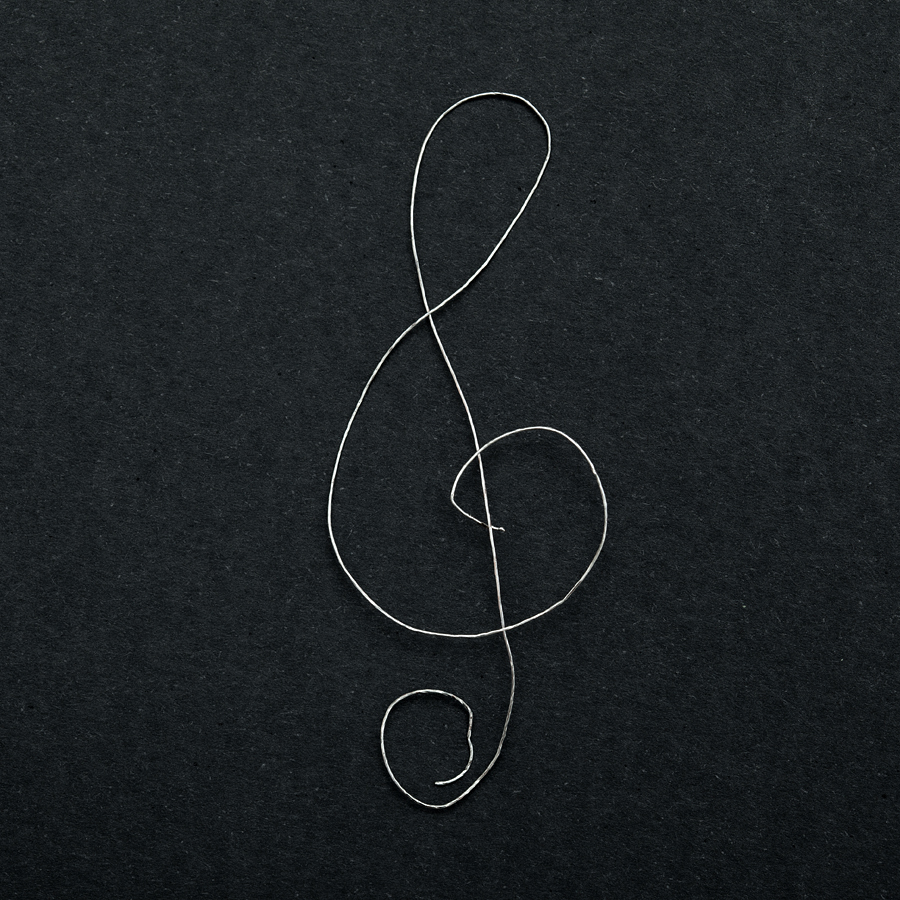
𝄞 | G-clef

In musical notation, a clef provides the reference point for the notes on the stave. For example, the G-clef is named so because the line passing through its curl corresponds to the note G. The fancy symbol 𝄞 evolved from the Latin letter “G”.

When placed on the second line of the stave, 𝄞 is called the treble clef. Its Russian name is скрипичный ключ because the music for violin (скрипка) is written in treble clef. This is the most commonly used clef today. No wonder this symbol grew to represent music in general — much to the chagrin of bass players.

More photos of guitar strings and silver @ Shutterstock.

Friday, 26 May 2017

♮ | natural

In musical notation, ♮ is a symbol for natural, an accidental used to cancel a flat or sharp from either a preceding note or the key signature. Like the sharp sign ♯, the natural sign is derived from a “square” b used to denote B♮ in Gregorian chant manuscripts.

In Russian musical slang, бекар (from French bécarre) stands for delay or cancellation of an event, a failure to fulfill promises etc.; the derived verbs бекарить and забекарить mean “to cancel”, “to skip”, or “be late”.

More photos of flowers @ Shutterstock.

Thursday, 25 May 2017

♭ | flat

In musical notation, ♭ is a symbol for flat (bemol) which is commonly found as an accidental or in key signatures. The symbol is derived derived from a stylised lower-case b, “b rotundum”.

In Russian musical slang, бемоль means “belly”.

More photos of bananas @ Shutterstock.

Wednesday, 24 May 2017

♯ | sharp

In musical notation, ♯ is a symbol for sharp (dièse) which is commonly found as an accidental or in key signatures. According to Wikipedia,

The modern accidental signs derive from the two forms of the lower-case letter b used in Gregorian chant manuscripts to signify the two pitches of B, the only note that could be altered. The “round” b became the flat sign, while the “square” b diverged into the sharp and natural signs.

They say that ♯ must not be confused with the # sign variously known as “hash”, “number sign” or “pound sign”. The truth is, there is very little scope for confusion of ♯ with # since ♯ is only used in the musical context. In fact, in pre-Unicode era, # was exactly the symbol for sharp (and lower-case b for flat) that was used in ASCII text files, and nobody would interpret F# as anything but F♯. On the contrary, there is every chance of confusion if you use it either as a number or pound sign. Personally, I resent these two uses. I mean, you must be really lazy to use # instead of № or No. As for “pound”, hello? Write lb. or switch to the metric system like the rest of the world.

If you really need to know the difference, look at the pictures. The sharp has two vertical chili peppers crossed by two slanted parallel peppers that rise from left to right. In this fashion, the slanted peppers won’t interfere with the staff lines. The hash has two horizontal peppers crossed by two slightly slanted parallel peppers.

More photos of chili peppers @ Shutterstock.