Showing posts with label metal. Show all posts

Tuesday, 30 January 2018

申 | shēn

In Mandarin Chinese, (Pinyin: shēn 🔊) has many meanings. As a verb, it can mean “to announce”, “to express”, “to explain”, “to state”, “to request”, “to report”, “to extend”, “to stretch”... As a noun, is the ninth of twelve earthly branches. It corresponds to the Year of the Monkey () of the Chinese zodiac; the seventh month; the hour of the Monkey (3 pm to 5 pm, “the time when Monkeys are lively”); and the direction 240° (where 0° is north). Its associated “fixed element” is Metal, . is also one of the alternative names of Shanghai.

Note that the character refers to any actual monkey or ape while refers to the zodiac animal. is derived from a pictogram for bolt of lightning, as can be seen in some historical forms of the character. However, it is unclear how lightning is connected to any of the modern meanings.

More photos related to monkeys, zodiac and sea glass @ Shutterstock.

Monday, 29 January 2018

猴 | hóu

But enough with barnyard animals, let’s move into more exotic territory. In Mandarin Chinese, (Pinyin: hóu) means “monkey” or “ape”. The Monkey is one of the twelve-year cycle of animals which appear in the Chinese zodiac and is associated with the earthly branch .

In her Chinese Calligraphy Sourcebook, Yat-Ming Cathy Ho writes about :

This intelligent character is agile in its movements. The right part of the character has a man on its left with bows and arrows at the bottom of the tree, ready to shoot. The left side often appears in characters relating to animals.

I’m sure that you too have noticed similarity between and characters for dog () and pig (). That’s right, all of them have the radical (“dog”) on the left! is a phono-semantic compound of and phonetic (hóu).

According to Wikipedia, Chinese polymath Li Shizhen (1518—1593) distinguished eleven varieties of monkeys:

A small one with a short tail is called Hou ([] monkey). If it looks like a monkey but has a prominent moustache, then it is called Ju []. If it looks like a monkey but is bigger, then it is Jue []. A monkey that is big, with red eyes and a long tail, is called Yu []. A monkey that is small but has a long tail and an upright nose is called You []. A monkey that is similar to You but is bigger is called Guoran [果然]. A monkey that is similar to You but smaller is called Mengsong [蒙頌]. A monkey that is similar to You but jumps a lot is called Canhu [獑猢]. A monkey that has long arms is called Yuan ([] ape). A monkey that is similar to Yuan but has a golden tail is called Rong []. A monkey that is similar to Yuan but bigger, and can eat apes and monkeys, is called Du [].

More photos related to monkeys, zodiac and sea glass @ Shutterstock.

Tuesday, 16 January 2018

酉 | yǒu

In Mandarin Chinese, (Pinyin: yǒu 🔊) is a useful word meaning “an alcoholic drink vessel” (such as bottle, jar and so on). is also the tenth of twelve earthly branches. It corresponds to the Year of the Rooster () of the Chinese zodiac; the eighth month; the hour of the Rooster (5 pm to 7 pm, “the time when Roosters begin to get back to their coops”); and the direction 270° (i.e. west). Its associated “fixed element” is Metal, . Note that the character refers to actual fowl while refers to the zodiac bird.

Does the shape of remind you anything? That’s right, it looks very much like the character . Only in case of we see the Greek letter π trying to get more visible, perhaps with a little help of a bench or something. In fact, has evolved from a pictogram of a jug (of wine).

More photos related to chickens, zodiac and sea glass @ Shutterstock.

Monday, 15 January 2018

鸡 | jī

In Mandarin Chinese, (Pinyin: 🔊) is a noun for “chicken” and domestic fowl in general. To be more specific, Chinese uses compounds, for example:

The Rooster is one of the twelve-year cycle of animals which appear in the Chinese zodiac and is associated with the earthly branch . The other meanings of include “prostitute” and “penis” (why I am not surprised?).

is a simplified form of the traditional character which is a phono-semantic compound of phonetic () and semantic “short-tailed bird”. Historical forms of this latter character show great diversity, depicting birds with assorted tails and in a variety of positions.

More photos related to chickens, zodiac and sea glass @ Shutterstock.

Sunday, 28 May 2017

𝄢 | F-clef

The F-clef is named so because the line passing between the two dots corresponds to the note F. The symbol 𝄢 evolved from the Latin letter “F”, its two horizontal strokes reduced to dots.

To me, 𝄢 is a more elegant symbol than 𝄞 (G-clef). The dots aside, 𝄢 looks very much like a golden spiral, i.e. a spiral whose growth factor is the golden ratio 𝜑. This inspired me to make the F-clef from an old gold-plated guitar string:

When placed on the fourth line of the stave, 𝄢 is called the bass clef. The bass clef is the only F-clef in modern use.

More photos of guitar strings and gold @ Shutterstock.

Saturday, 27 May 2017

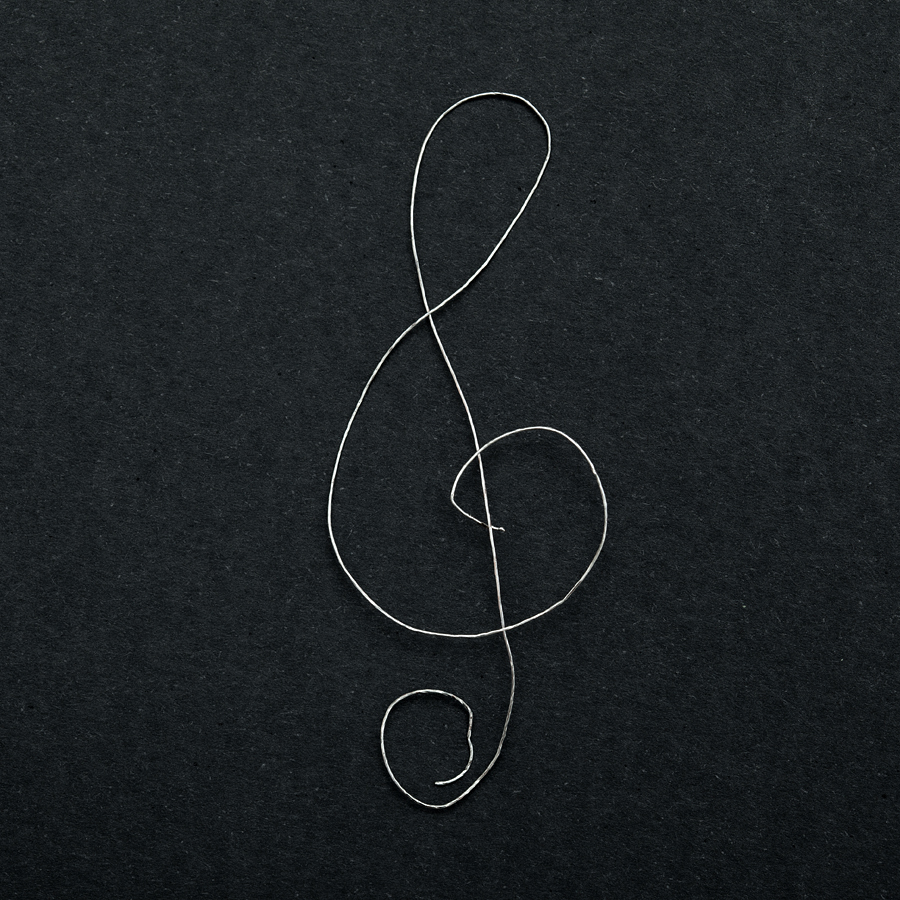
𝄞 | G-clef

In musical notation, a clef provides the reference point for the notes on the stave. For example, the G-clef is named so because the line passing through its curl corresponds to the note G. The fancy symbol 𝄞 evolved from the Latin letter “G”.

When placed on the second line of the stave, 𝄞 is called the treble clef. Its Russian name is скрипичный ключ because the music for violin (скрипка) is written in treble clef. This is the most commonly used clef today. No wonder this symbol grew to represent music in general — much to the chagrin of bass players.

More photos of guitar strings and silver @ Shutterstock.

Monday, 24 April 2017

⛢ | Uranus

and are the astronomical and astrological symbols representing the planet Uranus.

The planet got its name from the ancient Greek god of the sky Ouranos (Οὐρανός). It is the only planet in the Solar System named after the Greek deity. Uranus is not a classical planet and was unknown to alchemists.

According to Wikipedia,

The symbols for Uranus were created shortly after its discovery in 1781. One symbol, , invented by J. G. Köhler and refined by Bode, was intended to represent the newly discovered metal platinum; since platinum, commonly called white gold, was found by chemists mixed with iron, the symbol for platinum combines the alchemical symbols for iron, , and gold, . This symbol also combines the symbols of Mars () and the Sun () because in Greek mythology, Uranus represented heaven, and represents the combined power of Mars’ spear and the Sun. Another symbol, , was suggested by Lalande in 1784. In a letter to Herschel, Lalande described it as “un globe surmonté par la première lettre de votre nom” (“a globe surmounted by the first letter of your name”).

More photos of sky and sea glass @ Shutterstock.

Saturday, 22 April 2017

♄ | Saturn

is an astrological and astronomical symbol representing the planet Saturn.

This planet was named after Saturnus, the Roman god of agriculture, whose Greek counterpart was Cronus. In alchemical tradition, Saturn was associated with lead. The English word Saturday and Dutch zaterdag are derived from Latin Saturni dies, i.e. “day of Saturnus”.

But what about the symbol ? According to Wikipedia,

Saturn is usually depicted with a scythe or sickle, and the planetary symbol has apparently evolved from a picture of this attribute, in Kamateros (12th century) shown in a shape similar to the letter eta η, with the horizontal stroke added along with the “Christianization” of the other symbols <as we’ve already seen in the cases of Mercury and Venus> in the early 16th century.

More photos of sea glass @ Shutterstock.

Friday, 21 April 2017

♀ | Venus

“The mirror of Venus” is an astrological and astronomical symbol representing the planet Venus.

The planet was named after Venus, the Roman goddess of sex, love, beauty, fertility and prosperity. Her Greek counterpart was Aphrodite. In alchemical tradition, Venus was associated with copper.

In many Romance languages, the word for Friday originates from Latin Veneris dies, i.e. “day of Venus” (divendres, vendredi, venerdì, viernes, vineri); Venus even found her way to Breton and Welsh (Gwener). In Germanic laguages, this day (fredag, Freitag, Friday, vrijdag) became connected with Freyja and/or Frigg, even it is not clear whether they were the same or two different goddesses.

According to Wikipedia, the mediaeval symbol for Venus did not have a horizontal stroke, which was added later to form a Christian cross, while “the idea that the symbol represents the goddess’ hand mirror dates to the 19th century”. In biology, medicine and genealogy, symbolises the female sex; in sociology and gender politics, the female gender.

More photos related to mirrors, copper and sea glass @ Shutterstock.
Thursday, 20 April 2017

♃ | Jupiter

is an astrological and astronomical symbol representing the planet Jupiter.

The Romans identified this planet with Jupiter aka Jove, the god of sky and thunder. His Greek counterpart was Zeus. In alchemical tradition, Jupiter was associated with tin.

In Romance languages, the word for Thursday originates from Latin Iovis dies, i.e. “day of Jove” (dijous, giovedì, jeudi, joi, jueves, xoves). In Germanic laguages, this day is connected with god Thor or Donar (donderdag, Donnerstag, Thursday, torsdag).

According to Wikipedia, the “less-than-intuitive symbol” has been variously interpreted as the letter ζ (for Ζεύς, “Zeus”), lightning bolt, or even “Egyptian hieroglyph for the eagle”. For me it is easier to remember as a symbol for Thursday, the fourth day of the week. I write the number “four” like 4, which also happen to be similar to Ч, the first letter of the Russian word четверг (Thursday).

More photos of sea glass @ Shutterstock.

Wednesday, 19 April 2017

☿ | Mercury

is an astrological and astronomical symbol representing the planet Mercury.

The planet was named after the Roman messenger god, Mercury, whom the Romans identified with the Greek god Hermes. The symbol is a simplified version of caduceus (a staff entwined by two serpents) carried by Mercury/Hermes. In alchemical tradition, Mercury was associated with quicksilver (mercury).

In Romance languages, the word for Wednesday originates from Latin dies Mercurii, i.e. “day of Mercury” (mercredi, mercoledì, miércoles, miercuri). In Germanic laguages, this day became connected with god Odin or Wōden (onsdag, Wednesday, woensdag).

More photos of sea glass @ Shutterstock.

Monday, 17 April 2017

☽ | Moon

The crescent is a symbol representing the Moon. Note the similarity between and archaic forms of Chinese character (yuè).

In alchemical tradition, the Moon was associated with silver. In many European languages, the word for Monday originates from Latin Lunae dies, i.e. “moon day”, after Roman goddess Luna (lundi, lunedì, lunes, luni) or Germanic god Máni (maanantai, maandag, måndag, Montag, etc.). Other lunar deities include goddesses Anumati, Artemis, Chang’e, Hecate, Hina, Isis, Kuu, Mama Killa, Phoebe, Selene and Yemaya, as well as gods Ay Ata, Bahloo, Jarilo, Sin, Thoth and Tsukuyomi.

The crescent, typically in decrescent orientation , is associated with Islam. Its combination with a five-pointed star, the star and crescent , is used in a number of national flags. The flag of the Comoros shows the crescent and four stars; the Flag of Singapore has the crescent and five stars. The flag of the Maldives features a crescent without any stars.

More photos of moon and sea glass @ Shutterstock.

Thursday, 16 March 2017

日 | rì

In Mandarin Chinese, (Pinyin: 🔊) means “Sun”, “daytime” (time between sunrise and sunset), and, by extension, “day” (i.e. twenty-four hours). It is also short for 日本 (Rìběn), “the Sun’s origin”, that is, Japan. Combining and , we get 日出 (rìchū 🔊), “sunrise”.

Just like (), can be used in a sense “to have sex”. It is not clear how this meaning originated. It could be that some of the historical forms of the character were suggestive of this vital activity. Note the similarity with the Western solar symbol, , which is also the alchemical symbol for gold.

More photos of sun and sea glass @ Shutterstock.

Friday, 24 February 2017

金 | jīn

In Mandarin Chinese, (Pinyin: jīn 🔊) means “gold” or “metal”.

Metal is one of the five elements of Wǔ Xíng. The ancient meaning of (now obsolete) was “copper”. Ponte Ryūrui says that “is a pictograph of copper ore cast in a mould”. You are unlikely to remember that, however, unless you have studied metallurgy. Alternatively, you can think of as a representation of a Chinese bell made of bronze or some other copper alloy. Uncle Hanzi gives a number of historical forms of this character that look convincingly like such bells.

More photos of metals and sea glass @ Shutterstock.