Showing posts with label spiral. Show all posts

Friday, 11 September 2020

꩜ | spiral

꩜

Just like the eight-pointed “Guanche sun” (or star), the spiral is something that you’re bound to see wherever you go in Canaries. It is also featured prominently in the art of Canarian artists such as Óscar Domínguez, Martín Chirino and Manolo Millares.

꩜

Of course, there is nothing specifically “Guanche” about it: the spiral is one of the most universal symbols. We are surrounded by natural and man-made spirals: callas, cinnamon buns, fern shoots, Romanesco buds, seashells, snails, staircases, sushi rolls, vinyl grooves, violin scrolls, waves and wreaths. The spiral is found in many symbols, including @, lauburu, G-clef and F-clef. In Cham, the character ꩜ is a punctuation mark for the beginning of a section.

꩜

Juan Eduardo Cirlot wrote in his Dictionary of Symbols:

Spiral: A schematic image of the evolution of the universe. It is also a classical form symbolizing the orbit of the moon, and a symbol for growth, related to the Golden Number, arising <...> out of the concept of the rotation of the earth. In the Egyptian system of hieroglyphs the spiral — corresponding to the Hebrew vau — denotes cosmic forms in motion, or the relationship between unity and multiplicity. <...> Be that as it may, the spiral is certainly one of the essential motifs of the symbolism of ornamental art all over the world, either in the simple form of a curve curling up from a given point, or in the shape of scrolls, or sigmas, etc.

꩜

More photos related to Guanches, spirals, beads and sea glass @ Shutterstock.

Tuesday, 29 October 2019

lauburu

Pop into any souvenir shop in the Basque Country, stroll through the old town of Bilbao and you’ll see it. It’s everywhere. So on my way from Bilbao I bought a box of lauburu-shaped candies to make, um, a bigger lauburu, why not.

According to Wikipedia, lauburu or Basque cross “is a symbol of the Basque Country and the unity of the Basque people”, in spite of its almost certainly non-Basque origin. Just like swastika, lauburu could be either left-handed or right-handed.

The word lauburu is probably derived from Latin labarum (as in Cantabrian labarum), folk-etymologically reinterpreted by Basques as “four heads” (lau “four” + buru “head”). It is highly unlikely that it was the other way round, as one Fidel Fita suggested, viz. that labarum was adapted by Romans from Basque.

More photos related to lauburu, Basque country and candy @ Shutterstock.

Sunday, 28 May 2017

𝄢 | F-clef

The F-clef is named so because the line passing between the two dots corresponds to the note F. The symbol 𝄢 evolved from the Latin letter “F”, its two horizontal strokes reduced to dots.

To me, 𝄢 is a more elegant symbol than 𝄞 (G-clef). The dots aside, 𝄢 looks very much like a golden spiral, i.e. a spiral whose growth factor is the golden ratio 𝜑. This inspired me to make the F-clef from an old gold-plated guitar string:

When placed on the fourth line of the stave, 𝄢 is called the bass clef. The bass clef is the only F-clef in modern use.

More photos of guitar strings and gold @ Shutterstock.

Saturday, 27 May 2017

𝄞 | G-clef

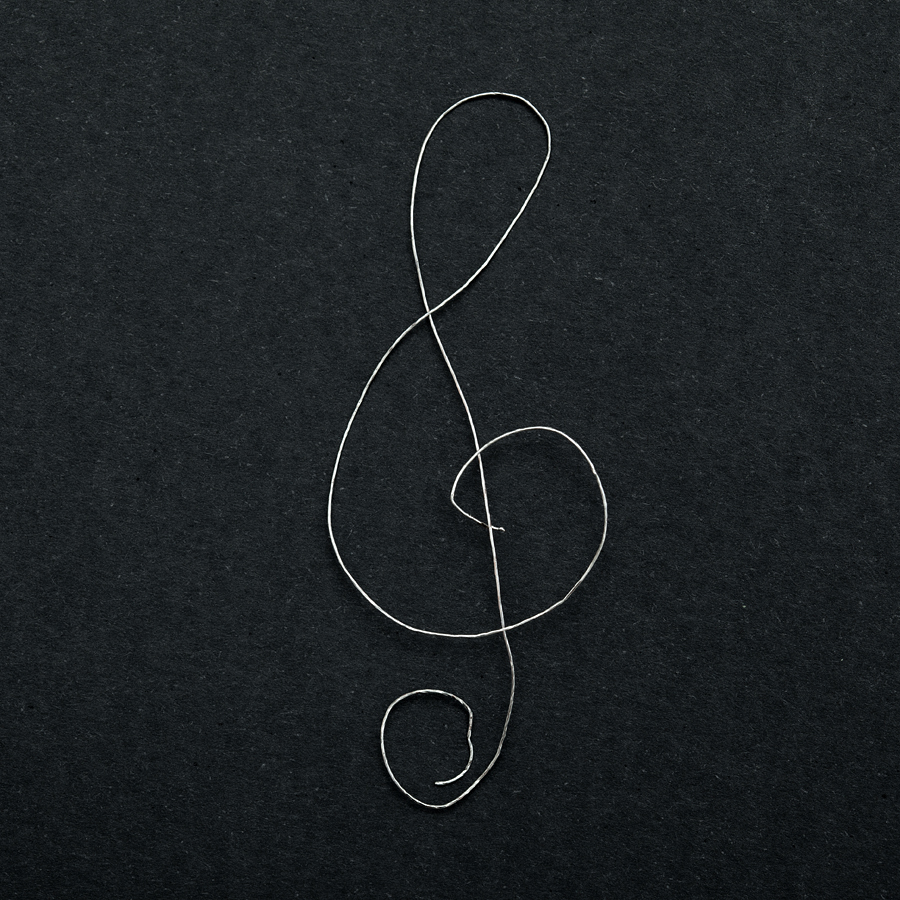
In musical notation, a clef provides the reference point for the notes on the stave. For example, the G-clef is named so because the line passing through its curl corresponds to the note G. The fancy symbol 𝄞 evolved from the Latin letter “G”.

When placed on the second line of the stave, 𝄞 is called the treble clef. Its Russian name is скрипичный ключ because the music for violin (скрипка) is written in treble clef. This is the most commonly used clef today. No wonder this symbol grew to represent music in general — much to the chagrin of bass players.

More photos of guitar strings and silver @ Shutterstock.

Wednesday, 1 March 2017

回 | huí

In Mandarin Chinese, 回 (Pinyin: huí 🔊) means “to return”, “to turn around”, “to reply”, or “to decline”.

There is a variety of historical forms of this character, including concentric circles and spiral shapes. For handwriting purposes, I think it is still easier to draw a spiral than a pair of concentric squares.

More photos of spirals and sea glass @ Shutterstock.