Showing posts with label biology. Show all posts

Thursday, 8 June 2017

ψ | psi

The letter ψ (psi) was yet another Greek addition to the alphabet, placed after the letters of Phoenician origin, along with φ, χ and ω. According to Wikipedia,

The letter’s origin is uncertain. It may or may not derive from the Phoenician alphabet. It appears in the 7th century BC, expressing /ps/ in the Eastern alphabets, but /kʰ/ in the Western alphabets (the sound expressed by Χ in the Eastern alphabets).

The letter ψ has a number of uses in maths and sciences, including

More photos related to letters, numbers and sea glass @ Shutterstock.

Wednesday, 7 June 2017

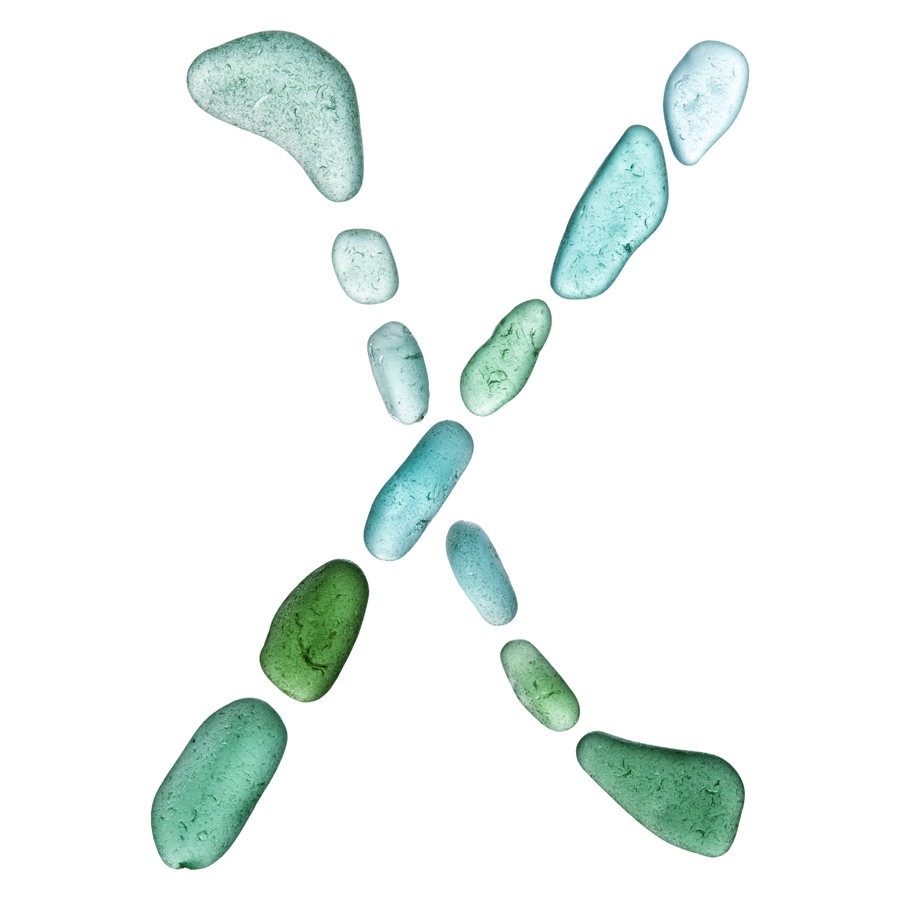
χ | chi

The letter χ (chi) was a Greek addition to the alphabet, placed after the letters of Phoenician origin, along with φ, ψ and ω. According to Wikipedia,

In Ancient Greek, ‘Χ’ and ‘Ψ’ were among several variants of the same letter, used originally for /kʰ/ and later, in western areas such as Arcadia, as a simplification of the digraph ‘ΧΣ’ for /ks/. In the end, more conservative eastern forms became the standard of Classical Greek, and thus ‘Χ’ (Chi) stands for /kʰ/ (later /x/). However, the Etruscans had taken over ‘Χ’ from western Greek, and it therefore stands for /ks/ in Etruscan and Latin.

The Greek χ gave rise to the Latin X, Gothic enguz 𐍇 and Cyrillic Х.

The lower-case χ has a number of uses in maths and sciences:

More photos related to letters, numbers and sea glass @ Shutterstock.
Tuesday, 6 June 2017

μ | mu

The Greek letter μ (mu) arose from the ancient Phoenician letter 𐤌 (mēm) which, in turn, was derived from the Egyptian hieroglyph for water, 𓈖.

The lower-case μ has many uses in maths, engineering and sciences, for example:

More photos related to letters, numbers and sea glass @ Shutterstock.

Thursday, 1 June 2017

τ | tau

The Greek letter τ (tau) was derived from the ancient Phoenician letter 𐤕 (tāw) which, in turn, was derived from an Egyptian hieroglyph ✕ meaning “mark”.

The lower-case τ has many uses in maths, engineering and sciences, such as

More photos related to letters, numbers and sea glass @ Shutterstock.

Wednesday, 31 May 2017

ω | omega

The letter ω (omega) is the 24th and last letter of the Greek alphabet. It was first introduced in the 7th century BC as a broken-up at the side variant of omicron. This letter was adopted into the early Cyrillic alphabet as Cyrillic omega (Ѡ, ѡ), with both upper- and lower-case letters similar to the Greek lower-case ω.

The lower-case ω has quite a few uses in maths, engineering and sciences, for example

More photos related to letters, numbers and sea glass @ Shutterstock.

Tuesday, 30 May 2017

ρ | rho

The Greek letter ρ (rho) was derived from the ancient Phoenician letter 𐤓 (rēš), which is thought to have come from a pictogram of a head. As a numeral, ρ has a value of 100. Incidentally, this is our 100th post.

The lower-case ρ (or its variant ϱ) has many uses in maths and sciences, such as:

More photos related to letters, numbers and sea glass @ Shutterstock.

Tuesday, 23 May 2017

σ | sigma

The Greek letter σ (sigma) was derived from the ancient Phoenician letter 𐤔 (šīn) which meant “tooth”.

ς is the lower-case letter sigma (σίγμα τελικό) when used as the final letter in a word.

The lower-case σ has been widely adopted in maths and sciences, for instance:

More photos related to letters, numbers and sea glass @ Shutterstock.
Monday, 22 May 2017

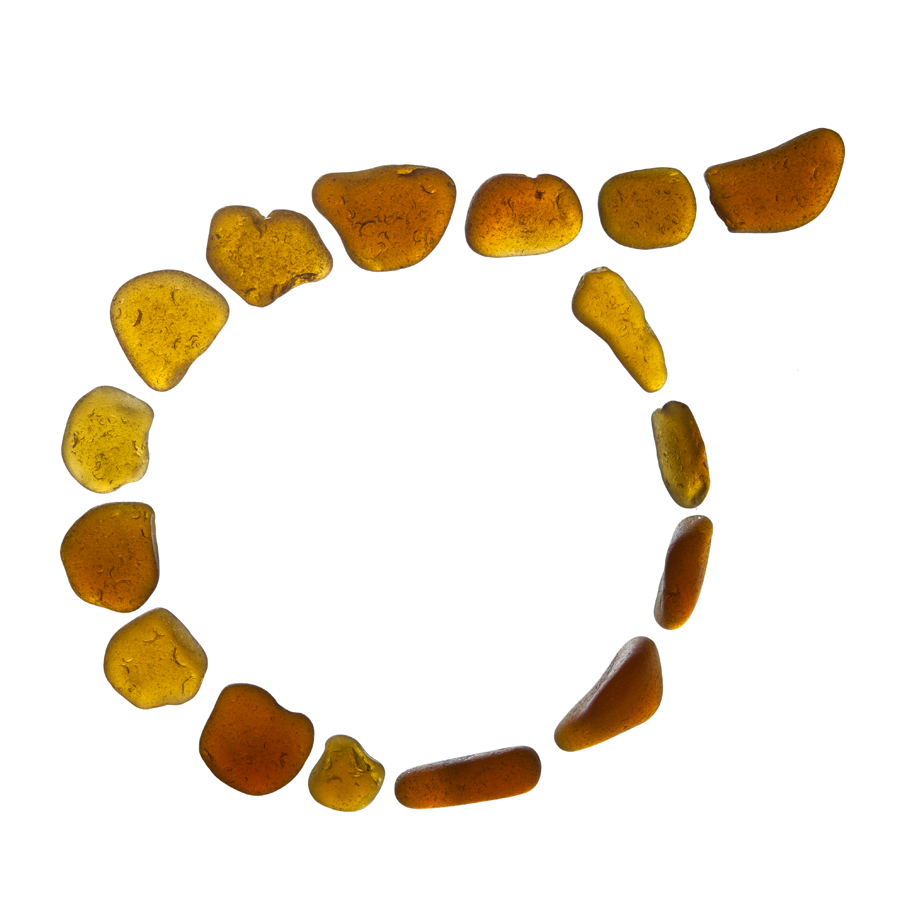
λ | lambda

The Greek letter λ (lambda) was derived from the ancient Phoenician letter 𐤋 (lāmed) which meant “goad” (a cattle prod).

The lower-case letter λ has many uses in maths, engineering and sciences, including:

λ is also one of the international symbols for LGBT rights.

More photos related to letters, numbers and sea glass @ Shutterstock.

Sunday, 21 May 2017

κ | kappa

The Greek letter κ (kappa) was derived from the ancient Phoenician letter 𐤊 (kāp) which meant “palm” (of a hand).

The lower-case κ is pretty much just a smaller version of the upper-case Κ and is virtually indistinguishable from the upper-case Roman K as well as the Cyrillic К/к. I prefer using the cursive ϰ.

The lower-case κ and/or cursive ϰ have quite a few uses in maths, engineering and sciences, for instance:

More photos related to letters, numbers and sea glass @ Shutterstock.

Saturday, 20 May 2017

ι | iota

The Greek letter ι (iota) was derived from the ancient Phoenician letter 𐤉 (yōd) which meant “arm”. The archaic Cyrillic iota ꙇ looks exactly the same.

The lower-case ι looks too similar to the Latin letters i and l to be widely used as a symbol on its own. Still, it has been adopted in maths and sciences, for instance:

  • in biochemistry: ι-toxin, a pore forming toxin from Clostridium perfringens
  • in mathematical logic: a definite description operator
  • in natural product chemistry: ι-carrageenan, a polysaccharide extracted from red algae that gels in the presence of calcium ions

More photos related to letters, numbers and sea glass @ Shutterstock.

Wednesday, 17 May 2017

θ | theta

The Greek letter θ (theta) was derived from the ancient Phoenician letter 𐤈 (ṭēt) which meant “wheel”. The Cyrillic letter Ѳ (fita), derived from θ, was a part of the Russian alphabet until 1918. Gogol wrote in a footnote to Dead Souls:

«Ѳетюкъ — слово обидное для мужчины, происходитъ отъ Ѳ, буквы, почитаемой нѣкоторыми неприличною буквою.»
(“Thetuk” is an offensive word to a man, it comes from Ѳ, a letter thought by some indecent.)

Speaking of decency: according to Real Academia Española, this letter should be called zeta, perhaps to avoid using the word teta, while the letter ζ is supposed to be called dseta.

The lower-case letter θ has quite a few uses in maths and sciences, for instance:

More photos related to letters, numbers and sea glass @ Shutterstock.

Sunday, 14 May 2017

ζ | zeta

The Greek letter ζ (zeta) was derived from the ancient Phoenician letter 𐤆 (zayin) which meant “sword” or some other weapon.

In the system of Greek numerals, the letters α to ε have the respective values 1 through 5. Bizarrely, ζ has the value of 7. This may account for the fact that chemists don’t like using Greek letters beyond ε when numbering the atoms in the chain. Still, the lower-case letter ζ has some uses in maths and sciences, for example:

More photos related to letters, numbers and sea glass @ Shutterstock.

Friday, 12 May 2017

ε | epsilon

The Greek letter ε (epsilon) was derived from the ancient Phoenician letter 𐤄 (hē) which meant “window”. In its turn, ε gave rise to the Latin e and a number of other letters.

The lower-case letter ε has a number of uses in maths and sciences:

α through ɛ appears to be the extent to which most people know the letter sequence of the Greek alphabet.

More photos related to letters, numbers and sea glass @ Shutterstock.

Thursday, 11 May 2017

δ | delta

The Greek letter δ (delta) was derived from the ancient Phoenician letter 𐤃 (dālet) which, in turn, was derived from 𓉿, an Egyptian hieroglyph depicting a door.

The lower-case letter δ has many uses in maths and sciences, such as:

More photos related to letters, numbers and sea glass @ Shutterstock.

Wednesday, 10 May 2017

γ | gamma

The Greek letter γ (gamma) was derived from the ancient Phoenician letter 𐤂 (gīml). One theory says that it represented a throwing stick, another links it to (an image of) a camel.

The lower-case letter γ has a number of uses in maths and sciences, for example:

  • in astronomy: the third brightest star in a constellation. For instance, Bellatrix is designated as γ Orionis.
  • in inorganic chemistry: a symbol for certain allotropes, for example γ-iron (austenite) or γ-sulfur
  • in mathematics: the Euler—Mascheroni constant, a mathematical constant with approximate value of 0.57721
  • in organic chemistry: γ-carbon, the third carbon atom in a chain when counting from a functional group. The names such as γ-aminobutyric acid (GABA) make use of this nomenclature.
  • in neurophysiology: γ-waves, a type of brain waves detected by electroencephalography
  • in phonetics: voiced velar fricative (IPA symbol ɣ)
  • in physics: γ is the symbol for a photon, probably derived from γ-rays or γ-radiation, a kind of electromagnetic radiation arising from the radioactive decay (γ-decay)
  • in special relativity: Lorentz factor

More photos related to letters, numbers and sea glass @ Shutterstock.

Tuesday, 9 May 2017

β | beta

The Greek letter β (beta) was derived from the ancient Phoenician letter 𐤁 (bet). The word alphabet originates from the Greek ἀλφάβητος (alphabētos), from ἄλφα (“alpha”) + βῆτα (“beta”).

The lower-case letter β has found many uses in maths and sciences:

  • in astronomy: the second brightest star in a constellation. For instance, Rigel is designated as β Orionis
  • in biochemistry: β-sheet, a type of protein secondary structure
  • in biology: β cell, a type of cell found in the pancreatic islets of the pancreas. The primary function of a β cell is to produce insulin.
  • in inorganic chemistry: a symbol for certain allotropes, for example β-tetragonal boron, β-germanium, and β-tin
  • in mathematics: β(s), the Dirichlet beta function
  • in natural product chemistry: a stereodescriptor used in a number of different ways
  • in nuclear physics: beta particle, a high-energy electron (β−) or positron (β+) emitted in the radioactive decay; β-decay is a radioactive process in which an atomic nucleus emits an β-particle
  • in organic chemistry: β-carbon, the second carbon atom in a chain when counting from a functional group
  • in pharmacology: β1, β2 and β3, subtypes of adrenergic receptors
  • in phonetics: voiced bilabial fricative (IPA symbol β)
  • in special relativity: a symbol for the speed of an object relative to the speed of light: β = v/c
  • in thermodynamics and fluid mechanics: a symbol for compressibility
  • in zoology: β animals, which often act as second-in-command to the reigning α-males and/or α-females

More photos related to letters, numbers and sea glass @ Shutterstock.

Monday, 8 May 2017

α | alpha

The Greek letter α (alpha) was derived from the ancient Phoenician letter 𐤀 (ʾālep) which, in turn, was derived from 𓃾, the Egyptian hieroglyph of an ox’s head.

The lower-case letter α has found many uses in maths and sciences:

  • in astronomy: the brightest star in a constellation. For instance, Betelgeuse is designated as α Orionis
  • in biochemistry: α-helix, a type of protein secondary structure
  • in inorganic chemistry: a symbol for certain (usually the most common) allotropes, for example α-iron, α-phosphorus, and α-sulphur
  • in natural product chemistry: a stereodescriptor used in a number of different ways
  • in navigation: a symbol for azimuth
  • in neurophysiology: α-waves, a type of brain waves detected by electroencephalography
  • in nuclear physics: alpha particle, α or α2+, a historical name of doubly ionised helium nuclei (He2+) ; α-decay is a radioactive process in which an atomic nucleus emits an α-particle
  • in organic chemistry: the α-carbon is the first carbon atom attached to a functional group; α-amino acids are amino acids with an amino group bound directly to the α-carbon
  • in pharmacology: α1 and α2, subtypes of adrenergic receptors
  • in physics: a symbol for angular acceleration
  • in physics: the fine-structure constant
  • in zoology: α-males and α-females, the highest ranking individuals in a community of social animals

More photos related to letters, numbers and sea glass @ Shutterstock.